Cold Water, Clear Mind: Scotland's Wild Swimming Sanctuaries for Women Who Dare
Cold Water, Clear Mind: Scotland's Wild Swimming Sanctuaries for Women Who Dare
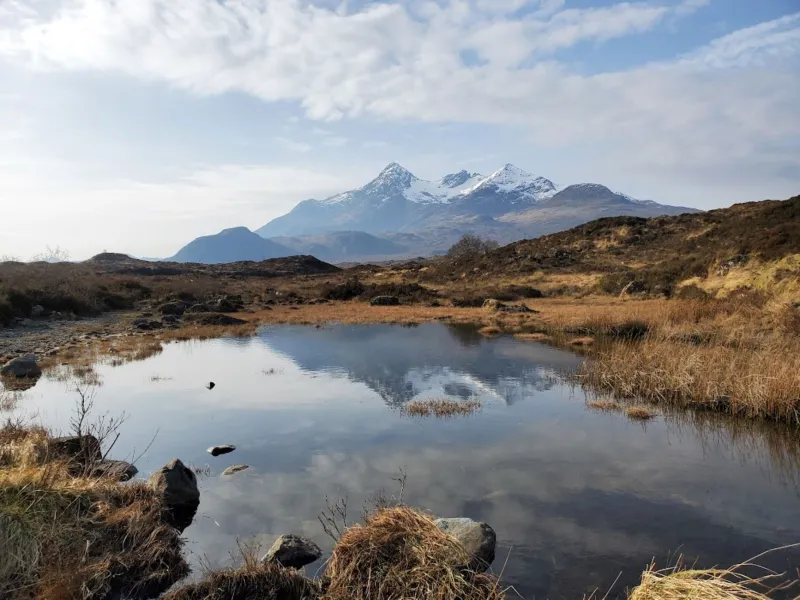
There is a particular kind of silence that exists only at the edge of a Scottish loch at dawn. The water sits perfectly still, copper-dark and ancient, reflecting the sky above as though the surface were polished obsidian. Then you step in — and the cold takes your breath entirely.
This is wild swimming in Scotland. Not the sanitised, Instagram-curated version, but the real thing: icy, humbling, and utterly transformative. For women who have grown weary of pool lanes and package holidays, Scotland's waterways offer something far more precious — genuine immersion in one of Europe's last great wildernesses, available without a passport, without a long-haul flight, and without surrendering the radical act of being alone with nature.
This guide is for the fearlessly curious. Those who want to feel small in the best possible way.
The Sea Pools of the Isle of Skye: Where the Atlantic Meets the Ancient
Skye is many things — brooding, cinematic, perpetually mist-wreathed — but few visitors discover its extraordinary tidal pools, sculpted by millennia of Atlantic force into natural swimming bowls along the Trotternish coastline. The pools near Staffin are particularly remarkable: accessible via a short coastal walk, they fill and empty with the tides, creating a sequence of perfectly temperature-layered swims ranging from bracingly cold to merely very cold.
The Fairy Pools near Glenbrittle are perhaps Skye's most celebrated swimming destination, and rightly so. Fed by the Allt Coir' a' Mhadaidh river cascading down from the Cuillin mountains, these crystalline turquoise pools are connected by a series of small waterfalls. Arrive before nine in the morning from late May through August to experience them in relative solitude; by midday they draw considerable crowds. The water temperature rarely exceeds 12°C even in summer, so acclimatise gradually — wade before you plunge.
Best season: Late May to early September. The long Scottish summer evenings offer golden-hour swims that feel almost mythological.
The Cairngorms: Swimming in Peat and Prehistory
The lochs of the Cairngorms National Park carry a particular quality of wildness that is difficult to articulate and impossible to forget. The water is stained amber by peat — a natural filtration that renders it extraordinarily clean — and the surrounding landscape of ancient Caledonian pine forest and high moorland creates an atmosphere of profound, unhurried solitude.
Loch Morlich, near Aviemore, is the most accessible entry point: a large, sandy-shored loch that warms marginally in summer and provides a genuinely beautiful swim with views of the Cairngorm plateau. For something more remote, Loch an Eilein — whose ruined island castle dates to the fifteenth century — rewards the thirty-minute forest walk required to reach it with swimming conditions of almost surreal beauty.
For experienced wild swimmers seeking true remoteness, the high-altitude lochans above 600 metres — accessible via the funicular railway and then on foot — offer an experience that borders on the spiritual. These are not swims to be undertaken lightly; water temperatures can remain close to freezing even in July, and weather can change with startling speed. Go prepared, go informed, and ideally go with someone who knows the terrain.
Best season: July and August for the high lochans. Loch Morlich and Loch an Eilein can be swum from June through October by those comfortable with cold water.
Glencoe and the River Coe: Drama and Depth
Glencoe's landscape is operatic — all towering ridgelines and shadowed valleys — and its river pools match the scenery in intensity. The River Coe drops through a series of deep, clear pools as it descends from Rannoch Moor, each one a self-contained world of smooth granite and rushing water. The pools near the Clachaig Inn are particularly fine, and the inn itself provides the ideal post-swim restorative in the form of a dram of something peaty and warming.
This stretch of Scotland is particularly rewarding for women travelling solo or in small groups, as the valley has a well-established walking and outdoor community with a notably inclusive culture. The nearby Glencoe Mountain Resort also hosts guided wild swimming experiences during the summer months.
What to Pack: The Considered Wild Swimmer's Kit
Wild swimming in Scotland demands respect — for the environment and for your own body. The following essentials are non-negotiable:
- A good-quality wetsuit or neoprene swim top: Even in summer, Scottish water temperatures rarely exceed 15°C. A 3mm wetsuit will extend your comfortable swimming time considerably.
- Tow float: Highly recommended for open-water swimming. It increases your visibility to other water users and provides a resting point if needed.
- Dry robe or changing poncho: The post-swim chill is real. A full-length dry robe is worth every penny.
- Waterproof first aid kit: Blisters, cuts, and cold-related issues can arise quickly in remote locations.
- OS Maps and a fully charged phone: Mobile signal in rural Scotland is patchy at best. Download offline maps before you leave.
- A hot flask: Non-negotiable. Tea, coffee, or soup — the choice is yours, but warmth is essential.
Connecting with Scotland's Women-Led Wild Swimming Community
One of the most quietly revolutionary developments in British outdoor culture over the past decade has been the emergence of women-led wild swimming groups, and Scotland has produced some of the finest. The Wild Swimming Scotland Facebook community connects thousands of swimmers across the country, with members regularly sharing location updates, safety advice, and organised group swims.
In Edinburgh, Capital Wild Swimmers organises regular group dips at locations including Portobello Beach and the Water of Leith, offering a welcoming entry point for nervous beginners. Further north, Highland Wild Swimmers is a Inverness-based group with a particularly strong ethos of environmental stewardship, regularly organising litter-picks alongside their swims.
For those seeking a more structured introduction, the Outdoor Swimming Society (outdoorswimmingsociety.com) maintains an excellent resource library specifically addressing the needs of women swimmers, including guidance on swimming alone safely and navigating the particular challenges of cold-water acclimatisation.
A Note on Safety and Responsibility
Scotland's wild swimming locations are largely unguarded and unregulated — which is precisely what makes them magnificent, and precisely why they demand your full attention. Cold water shock is a genuine risk; always enter water gradually rather than diving, regardless of how warm the day feels. Inform someone of your planned location and expected return time. Swim within your capabilities, and never swim alone in remote locations if you are new to wild swimming.
Leave no trace. Scotland's wild places belong to everyone — pack out everything you bring in, and resist the temptation to build cairns or disturb the natural environment.
The cold will take your breath. The beauty will return it. Scotland's wild waters are waiting.