After Dark, Finally Free: Why the Night City Belongs to the Solo Woman Traveller
There is a particular kind of dusk that arrives in certain cities — in Lisbon, say, when the fado drifts up through the Alfama like smoke, or in Bologna, when the porticoes fill with amber light and the evening's first aperitivo is poured — that makes the idea of retreating to a hotel room feel not merely premature, but like a small, unnecessary defeat.
And yet many of us do exactly that. We have absorbed, over years of well-meaning warnings and cautionary headlines, a quiet but persistent belief: that the city after dark is not quite ours. That the night, with its loosened rhythms and its shadows, is a territory where a woman alone is a vulnerability rather than a presence. We eat early. We plan our routes home before we have even arrived. We watch the light go out of the sky and begin, almost without noticing, to arrange our exit.
This piece is an invitation to stop doing that.
The Myth We Were Given
The narrative that darkness equals danger for women is not entirely invented — it is, in many parts of the world, grounded in genuine structural inequality and lived experience. To pretend otherwise would be dishonest, and Voyageuse has never been in the business of breezy reassurance at the expense of truth.
But there is a significant difference between exercising informed, situational awareness and surrendering the entire nocturnal world out of a generalised, inherited anxiety. The latter is not caution. It is a form of preemptive loss — and it costs us more than we tend to calculate.
What we lose, when we retreat indoors at dusk, is considerable. We miss the hour in Naples when the streets smell of frying dough and families spill onto pavements with a looseness that the daytime never quite allows. We miss the last tram in Prague, half-empty and golden-lit, rattling through neighbourhoods that no tourist map bothers to name. We miss the all-night bakeries of Paris — those fluorescent, flour-dusted rooms where baguettes emerge at two in the morning and the only other customer is a taxi driver who nods at you as though you are simply a person, which, of course, you are.
What the Night Actually Offers
Travel writers have long celebrated the sensory richness of daylight — the markets, the monuments, the blue-skied panoramas. But the night city operates on an entirely different register, and it is one that rewards the solitary traveller in ways the daytime rarely can.
Alone in the evening, you become permeable to a city in a way that is harder to achieve in company. In Seville, I once sat in a small bar near the Triana bridge until well past midnight, nursing a single glass of manzanilla and watching a flamenco dancer rehearse in the back room — not performing, just practising, over and over, the same eight counts of footwork. No one spoke to me. No one needed to. The evening offered something that no guided tour ever could: the sensation of being genuinely inside a place, rather than observing it from a respectful distance.
That quality of intimacy is the night's particular gift. Cities, after dark, become less curated. The tourist infrastructure — the queue management, the audio guides, the cheerful signage — largely shuts down, and what remains is something closer to the actual texture of a place. The lamplit piazza where old men play cards. The jazz bar in a Ljubljana cellar where the pianist has been playing the same standard for thirty years and shows no signs of stopping. The night market in Chiang Mai where the vendors are too tired to pitch and the transaction becomes, almost accidentally, a human one.
On Risk, Honestly Considered
None of this is to suggest that a woman alone at night should abandon the instincts that have always served her. Situational awareness — knowing where you are, having a route, trusting the feeling in your gut when something is not right — remains as relevant after dark as it does in daylight. There is no virtue in recklessness, and no editorial agenda here that requires you to pretend the world is uniformly safe.
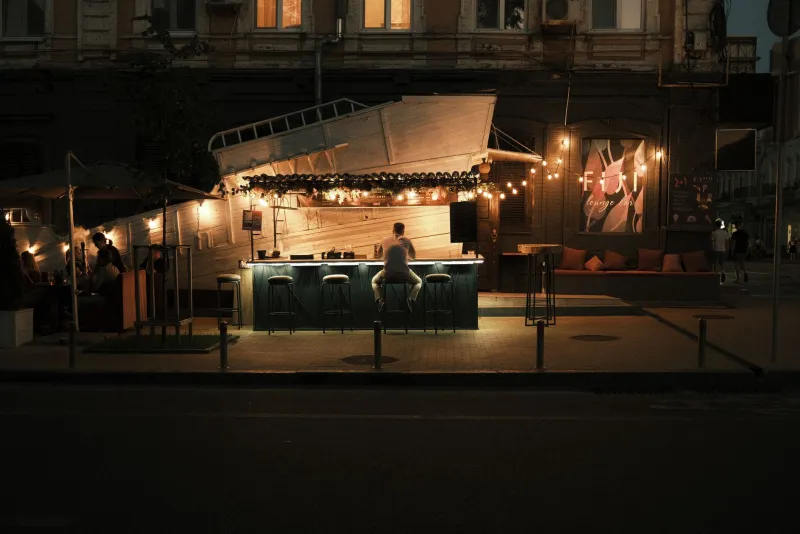
But risk, when examined honestly, is rarely the monolithic thing we are encouraged to believe it is. It is contextual, variable, and frequently overstated in ways that fall disproportionately on women. The same city that feels threatening in one neighbourhood at midnight may feel entirely benign in another. The same woman who would hesitate to walk alone down an unlit alley will sit perfectly at ease at a late-night bar counter, talking to the bartender about where to find the best sfogliatella in the morning.
The skill is not avoidance. It is calibration — and calibration improves, dramatically, with practice. The more evenings you spend navigating a city after dark, the more finely tuned your reading of it becomes. You learn which streets are empty because they are quiet and which are empty because something is wrong. You learn the body language of a city at rest versus a city on edge. You become, in the truest sense, more capable — not less.
The Women Already Out There
It is worth noting that the image of the solo woman nervously indoors by nine is already, in many parts of the world, an outdated fiction. Speak to women who travel regularly and you will find that the night is often where they locate their most vivid memories.
A friend who spent three months travelling through Japan describes the experience of arriving at a rural onsen town at eleven at night, the streets completely deserted, the lanterns reflected in a still river, and feeling — she is very specific about this — not frightened but held. Another, who has traversed much of South America alone, says that the evenings in Buenos Aires, where dinner does not begin until ten and the milongas run until dawn, gave her a confidence she has never quite lost.
These are not reckless women. They are informed, experienced, and deeply attentive. They have simply refused to let fear be the primary narrator of their travels.
A Different Kind of Courage
There is a form of bravery that travel asks of women which has nothing to do with climbing mountains or crossing deserts. It is quieter than that, and in some ways more demanding: the courage to occupy space, after dark, in a city that is not yours, and to do so not apologetically but with full presence.
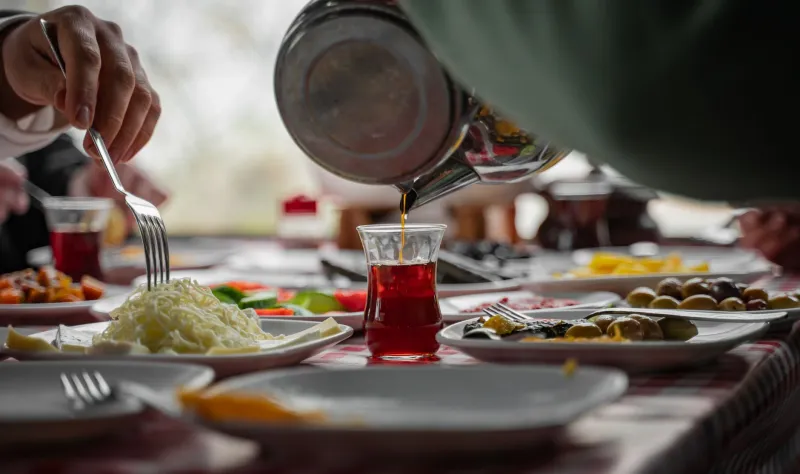
To order a late supper alone at a candlelit table and feel the pleasure of it without self-consciousness. To follow music into an unfamiliar street. To take the long way back to the hotel because the night air is warm and the city, at this hour, is finally, genuinely itself.
The midnight garden of someone else's city is real, and it is remarkable, and it has been waiting for you. The only thing required is that you stay long enough to see it bloom.