Between Islands: The Case for Crossing Greece Entirely by Sea
There is a particular kind of exhaustion that belongs exclusively to airports. The strip-lit corridors, the aggressive optimism of duty-free perfume, the low-grade anxiety of a boarding gate that may or may not change at any moment. It is a tiredness that has nothing to do with distance and everything to do with the erasure of the in-between — that precious, unhurried space between leaving somewhere and arriving somewhere else.
Greece, more than almost any other destination in Europe, offers a profound antidote. Its geography — a mainland trailing into a scattered archipelago of more than 200 inhabited islands — has always demanded a relationship with the sea. The ferries that thread between these islands are not merely a mode of transport. They are, for those willing to surrender to their rhythms, a form of travel philosophy.
Setting Out from Piraeus
The port of Piraeus, a short metro ride from central Athens, is the grand departure point for most Aegean crossings. It is chaotic, magnificent, and entirely itself — a place where passenger ferries the size of small apartment blocks sit alongside fishing vessels and the occasional superyacht with magnificent indifference to hierarchy. Arriving here with a rucksack and an open week ahead of you is one of the more liberating feelings available to the modern traveller.
The major ferry operators — Hellenic Seaways, Blue Star Ferries, and SeaJets among them — run services to the Cyclades, the Dodecanese, and the North Aegean islands. Booking a berth, rather than a seat, on an overnight crossing is the first and most important upgrade you can give yourself. A private cabin on a Blue Star ferry to Santorini or Rhodes is not the luxury it might sound; prices are reasonable by British standards, and what you receive in return is the particular magic of falling asleep to the sound of open water and waking, coffee in hand on the outer deck, as your island materialises through the morning haze.
The Sensory Life of the Open Deck
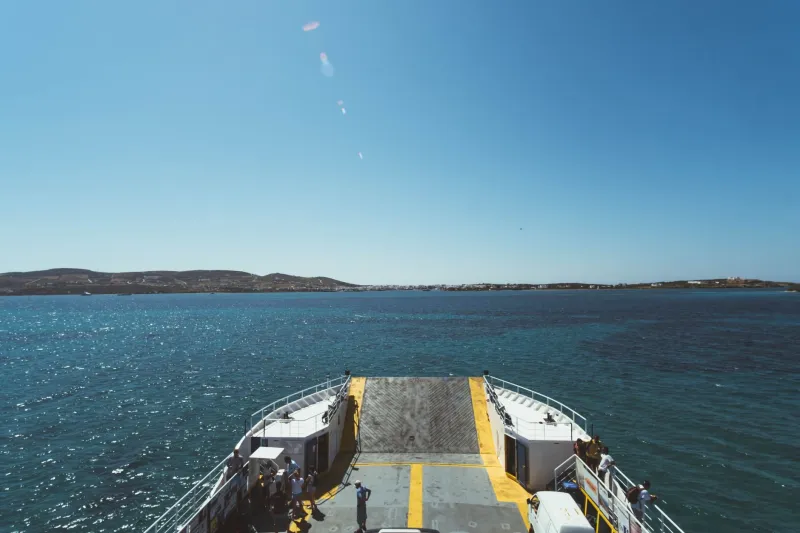
There is no airport lounge equivalent on a Greek ferry, and this is entirely to its credit. The outer decks belong to everyone — to the elderly Athenian couple returning to their village, to the young backpackers from all corners of Europe, to the solitary woman with a book and absolutely no obligation to make conversation with any of them.
The Aegean light at sea is a different quality altogether from the light on land. It refracts off the water in a way that makes everything feel slightly unreal, slightly heightened. The salt is in your hair within the first hour. The horizon — that clean, uninterrupted line between blue and blue — has a genuinely meditative effect that no amount of mindfulness content has ever quite managed to replicate.
Food on the longer crossings is taken in the ship's cafeteria: strong Greek coffee, spanakopita still warm from the oven, the occasional surprisingly decent grilled fish. It is not fine dining. It is, however, deeply satisfying in the way that food eaten whilst moving across open water always tends to be.
Practical Routes Worth Knowing
For a first ferry-based journey, the classic Cyclades circuit remains unimprovable. From Piraeus, take an overnight to Naxos — the largest and, many argue, the most authentically Greek of the Cyclades — and use it as your base. From Naxos, short hops to Paros, Ios, and Folegandros are all possible on day ferries, and the inter-island routes are frequent enough in summer to allow genuine spontaneity.
For those with more time, the Dodecanese route from Athens to Rhodes, calling at Kos and several smaller islands en route, is a longer commitment but a deeply rewarding one. The islands here have a distinct character — more Byzantine, more layered with history — and the crossings between them carry a sense of genuine remoteness that the more tourist-frequented Cyclades cannot always offer.
The North Aegean — Lesvos, Chios, Samos — is the route for the traveller who wants Greece without the summer crowds. These islands are larger, greener, and less trafficked by international tourism. The ferry journey from Piraeus to Lesvos takes approximately twelve hours and arrives, if you time it correctly, in the early morning light. There are fewer experiences in European travel quite as quietly extraordinary.
On Spontaneity as a Travel Strategy
One of the persistent myths of modern travel is that comprehensive pre-planning equals a better experience. The Greek ferry network gently dismantles this assumption. Whilst booking overnight cabin berths in advance is advisable in July and August, the inter-island day crossings rarely require more than a morning's notice, and the freedom this creates is not incidental — it is the entire point.
The woman who arrives in Paros and hears, from a stranger at a harbourside taverna, that the small island of Antiparos is worth the short crossing, and who acts on that information the following morning, is having a categorically different experience from the one who pre-booked every night six months earlier. She is, in the truest sense, travelling.
Connections happen on ferries that do not happen in airports or on aeroplanes. The enforced proximity of a long crossing, the shared experience of watching a sunset from a rolling deck, the conversations that begin over a shared table — these are the textures that make travel memorable rather than merely photogenic.
The Unhurried Return
There is a particular grace in choosing the slow route when the fast one is available. It is a statement about what you value: the quality of experience over the efficiency of arrival. The Greek ferry network, with all its occasional delays, its slightly weathered cafeteria chairs, and its spectacular indifference to the cult of speed, offers something increasingly rare in contemporary travel — the sensation that you have genuinely gone somewhere, rather than simply been transported.
The airport will be there when you need it. For now, the sea is waiting.