The Sketchbook as Compass: How Creative Travel Is Changing the Way Women See the World
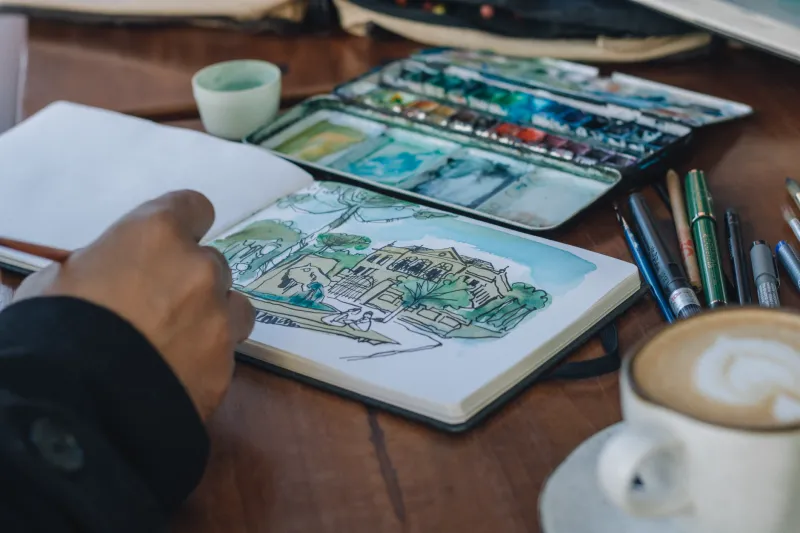
Consider what it means to look at something for twenty minutes. Not to glance at it, not to photograph it and move on, but to actually sit with it — to observe the way the light falls across the left side of a doorframe, to notice that the shadows beneath a market awning are not grey but a deep, shifting violet. Most of us, if we are honest, have not looked at anything that carefully since childhood.
This is what a sketchbook does to a journey. It does not simply record a place; it insists that you inhabit it.
Across the UK and beyond, a growing number of women are restructuring their travel lives around exactly this principle. They are choosing destinations not for their UNESCO status or their Instagram coordinates, but for the quality of the light in late afternoon, the texture of local clay, the particular green of a river in the Dordogne valley. They are travelling, in the fullest sense of the word, to see.
The Slow Gaze as Radical Act
The contemporary travel industry is, in many respects, built around the elimination of stillness. The relentless accumulation of experiences — the morning temple, the afternoon cooking class, the evening rooftop bar — creates a kind of motion that can feel, by the end of a fortnight, indistinguishable from the busyness one travelled to escape.
Art-led travel operates on an entirely different frequency. When your primary task for a morning is to sit in a Lisbon square and draw the facade of the building opposite, the city reveals itself in layers that no guided tour could replicate. You notice the woman who crosses the square at the same time each day. You learn, through the simple act of trying to render it accurately, that the azulejo tilework on the corner building is not a uniform blue but a complex interplay of at least four distinct shades. You become, without quite intending to, a temporary local.
Sarah Whitmore, a secondary school art teacher from Bristol who began booking painting retreats in her late thirties, describes the shift as transformative. "Before I started travelling with a sketchbook, I was consuming places," she says. "Now I feel like I'm actually in conversation with them. I come home knowing somewhere in a way I never did before, even from places I'd visited previously as a tourist."
Where Women Are Going — and What They Are Making
The geography of art-led travel is wonderfully varied, and the British women engaging with it are choosing their destinations with considerable intention.
The Dordogne valley in southwest France has long attracted watercolourists drawn to its golden limestone villages and generous summer light. Several UK-based tutors now run week-long painting retreats here between May and September, combining morning instruction with afternoon independent practice and evening meals in local farmhouses. These retreats attract a notably diverse age range — women in their thirties seeking a creative reset sit alongside retired professionals discovering painting for the first time — and the social dimension, the shared language of making, is frequently cited as one of the most unexpectedly nourishing aspects of the experience.
Lisbon has emerged as a compelling destination for life-drawing and urban sketching, its compact, hilly neighbourhoods offering an inexhaustible supply of architectural detail, human theatre, and extraordinary light. The city's thriving arts community means that workshops — ranging from single afternoon sessions to five-day intensives — are plentiful and accessible, and the urban sketching movement, which encourages drawing directly from the city rather than in a studio, has found particularly fertile ground here.
For those prepared to travel further, rural Japan — specifically the pottery regions of Mashiko, north of Tokyo, and the island of Naoshima in the Seto Inland Sea — has become a destination of pilgrimage for ceramicists and those wishing to learn the craft. Residency programmes here, some lasting several weeks, offer immersion not only in technique but in the broader Japanese philosophy of craft: the idea that the making of an object is inseparable from the attention, the ma, brought to its creation. For Emma Chen, a product designer from Edinburgh who spent three weeks at a Mashiko pottery studio last year, the experience recalibrated her relationship with both making and travel. "Japan teaches you that slowness is not inefficiency," she reflects. "It is the whole point."
Finding and Booking Art-Led Experiences
The market for creative travel has grown substantially in recent years, and the quality and variety of available programmes have grown with it. A few navigational notes for those considering the leap.
For painting and drawing retreats in Europe, organisations such as The Art House (thearthouseyorkshire.co.uk) and numerous independent tutor-led programmes advertised through the Society for All Artists (saa.co.uk) offer a reliable starting point. Reading the tutor's own work before booking is advisable — the quality of instruction is inseparable from the quality of the creative practice behind it.
For ceramics and craft residencies further afield, the British Council's artist residency database and platforms such as Residency Unlimited provide searchable listings, though many of the most rewarding programmes are found through word of mouth within craft communities. Following working ceramicists and painters on social media — not for aspirational content, but as a genuine research tool — often surfaces opportunities that do not appear in conventional travel searches.
It is also worth noting that not every art-led travel experience need be a structured programme. Arriving in a new city with a sketchbook and the intention to draw for one hour each morning costs nothing beyond the price of a decent set of watercolours and the willingness to look slightly eccentric at a pavement café. Many women find that this informal practice, begun tentatively on a single trip, quietly becomes the architecture around which all subsequent travel is organised.
The Thing You Bring Home
There is a particular quality to the souvenirs that art-led travel produces. Not the linen tea towel or the ceramic magnet, but the sketchbook page that captures, imperfectly and entirely personally, a specific afternoon in a specific place — the angle of shadow, the colour of a shutter, the face of someone who sat opposite you on a bench and did not know they were being observed.
These are records of genuine attention. They are proof, in the most intimate sense, that you were truly there.
The itinerary, however carefully constructed, cannot offer this. The sketchbook can offer nothing else.