Dear Someone, I Am Here: The Quiet Power of Writing Letters on the Road
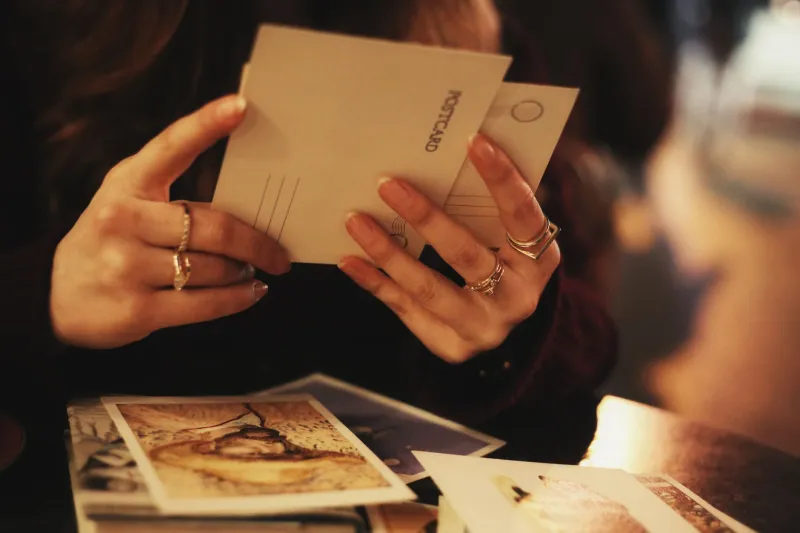
There is a particular kind of afternoon in Lisbon — the light going amber over the Tagus, a glass of vinho verde sweating gently on a marble tabletop — when reaching for your phone feels almost rude. Not to the other diners, but to the moment itself. It is precisely on one such afternoon that Miriam, a 38-year-old architect from Edinburgh, found herself instead reaching for a postcard. She had not written one in years. She was not entirely sure she remembered how.
"I sat there for almost twenty minutes," she recalls. "I kept starting and crossing out. And then I realised: that was the point. I was actually thinking about what I was seeing. Not just photographing it and moving on."
Miriam is not alone. Across the community of women who travel with intention — those who choose the slow train, the local market, the unmarked restaurant down the steep cobbled lane — a quiet return to correspondence is underway. Not as affectation. Not as aesthetic performance for a social feed. But as a genuine practice of presence.
The Broadcast vs. The Letter
We have grown extraordinarily efficient at communicating our whereabouts. A photograph posted in seconds. A location tagged before we have even finished our coffee. The mechanisms of modern travel sharing are seamless, frictionless, and — it must be said — rather hollow.
The Instagram story, however beautiful, is addressed to everyone and therefore, in some meaningful sense, to no one. It asks nothing of the sender and little of the recipient. It is a broadcast, not a conversation.
The letter is an entirely different proposition. It demands that you select a recipient — a specific human being with a specific history with you — and then compose something worthy of that relationship. You must decide what this person would find funny, moving, or worth knowing. You must, in the process, decide what you actually think.
"Writing to my mother is completely different from writing to my best friend," says Priya, a 44-year-old teacher from Bristol who has maintained a travel correspondence practice for nearly a decade. "With my mother, I describe the food in enormous detail. With my friend, I write about the strange, uncomfortable moments — the times I felt out of my depth or unexpectedly sad. Both letters make me understand my experience better. Together, they make me understand myself."
What You Leave Out
There is an editorial discipline to letter-writing that photography and social media actively resist. The camera captures everything. The letter cannot. You are forced to curate — and curation, as any editor will tell you, is where meaning is made.
Choosing what to include in a letter to someone you love is an act of interpretation. It says: this is what mattered. It says: this is the version of this place I want to carry forward. The act of omission is equally instructive. What you choose not to write — the bad meal, the moment of loneliness, the tourist trap you fell into despite yourself — is a form of private editing that clarifies, over time, what you are actually seeking when you travel.
Some women keep copies of the letters they send. Others save only the ones they receive in return. Either way, a correspondence becomes an archive — a record not merely of places visited, but of who you were when you visited them.
The Stationery as Ritual
Part of the pleasure, it must be acknowledged, is material. The weight of good paper. The smell of a new pen. The particular satisfaction of a well-placed stamp.
For those inclined to make correspondence a cornerstone of their travels, seeking out exceptional stationery is itself a worthwhile pursuit. In Lisbon, the venerable Papelaria Fernandes near the Chiado district has supplied the city's letter-writers for over a century, its shelves stacked with Portuguese-made notebooks, heavy cream envelopes, and ink in colours that seem to have been mixed from the city's own azulejo tiles. Further east, Il Papiro in Florence produces marbled papers using techniques unchanged since the Renaissance — a sheet of which, folded into a letter, arrives as a small work of art.
In Kyoto, the stationery culture reaches something approaching the philosophical. The craft of washi — handmade Japanese paper — is treated with the reverence accorded to any living art form, and shops such as Kyukyodo, operating near Nijo Castle since 1663, offer papers so beautiful that the act of writing upon them feels like a responsibility rather than a convenience.
For those who prefer the institutional romance of the great post office, few experiences rival dropping a letter into the ornate brass boxes of Dublin's GPO on O'Connell Street, or ascending the grand staircase of Paris's Hôtel des Postes on the Rue du Louvre. These are buildings that take correspondence seriously. Standing inside them, you are inclined to do the same.
Finding the Words
For women who have not written a personal letter since school, beginning can feel daunting. The blank page, away from home, in a language of emotion rather than information, is genuinely challenging. A few principles, offered not as rules but as starting points:
Write to the senses first. What did the place smell like this morning? What sound woke you? Sensory detail is the fastest route to genuine communication, and it anchors your correspondent in a world they cannot see.
Allow for ambivalence. The best travel letters are not postcards in prose — relentlessly sunny, superficially positive. They make room for confusion, for the place that didn't meet expectations, for the unexpected emotion that arrived without invitation. Honesty, even when uncomfortable, is what transforms a letter from a social obligation into a genuine gift.
Write slowly. This is not a text message. Give yourself the time the medium deserves. Order another coffee. Let the afternoon do what it will.
The Letter You Send Yourself
Several women interviewed for this piece mentioned a practice that initially sounds eccentric but reveals itself, on reflection, to be rather wise: writing a letter to themselves, to be opened at home, after the journey is over.
"I write it near the end of a trip," explains Josephine, a 52-year-old journalist from Manchester. "I describe who I was at the beginning of the journey versus who I feel I am now. What I wanted to leave behind. What I found instead. Then I seal it and don't read it until I've been home for at least a month."
The delay, she explains, is the point. "By the time I read it, I've already forgotten half of what I felt. The letter gives it back to me. It reminds me that travel actually changed something — which is easy to doubt once you're back in your ordinary life and the washing needs doing."
In an era that prizes speed above almost all else, there is something quietly radical about choosing to communicate slowly. About deciding that a moment is worth more than a post, that a person is worth more than a tag, that the experience of being somewhere extraordinary deserves to be held — in ink, on paper, in the hands of someone who will understand.
Write the letter. Seek out the stamp. Trust the post.
You are somewhere worth telling someone about.