The Interior Journey: On Carrying a Spiritual Practice Into Unknown Places
Let us dispense with the clichés immediately. There is no Bali in this piece. Nobody discovers themselves on a mountaintop and weeps with gratitude. No journal is described as transformative. If you have read a certain kind of travel writing before — the kind that arrives wearing linen and smelling faintly of palo santo — you will be relieved to know that this is not it.
What this is, instead, is an honest examination of something that a significant number of women are doing quietly, without Instagram documentation or retreat brochures: carrying a personal spiritual or contemplative practice into the unfamiliar territory of solo travel, and finding that displacement, far from disrupting that practice, has a strange tendency to deepen it.
The Sceptic's Admission
Many of the women who travel this way describe themselves, with some amusement, as reluctant converts to their own habits. Rachel, a 44-year-old architect from Edinburgh who has been travelling solo for fifteen years, began meditating not as a spiritual exercise but as a practical response to insomnia. She now considers her twenty-minute morning practice the single most consistent element of her life — more reliable than any relationship, more portable than any possession.
"I started taking it abroad almost by accident," she says. "I was in Lisbon, couldn't sleep, sat on the floor of my apartment and did the thing I do at home. And something about being in a completely unfamiliar room, with unfamiliar sounds outside the window, made it land differently. More present, somehow. I've been doing it in hotel rooms and guesthouses ever since."
This is a sentiment that recurs in various forms among women who have made contemplative practice a deliberate travel companion. The unfamiliar environment does not scatter the ritual — it illuminates it.
Why Displacement Sharpens Rather Than Scatters
There is a reasonable psychological explanation for this phenomenon. At home, the infrastructure of daily life — the commute, the inbox, the particular quality of light through your own kitchen window — constitutes a kind of noise that is easy to stop hearing precisely because it is so constant. Abroad, that background has been removed. The mind, deprived of its familiar furniture, becomes more attentive.
For women who meditate, this tends to manifest as a quality of presence that is harder to achieve in the domestic setting. For those who journal, it often produces writing of unusual candour — the kind that emerges when the social context that usually moderates self-disclosure has been temporarily suspended. You are not who your colleagues know, or who your family expects. You are, for the duration of the journey, more entirely yourself.
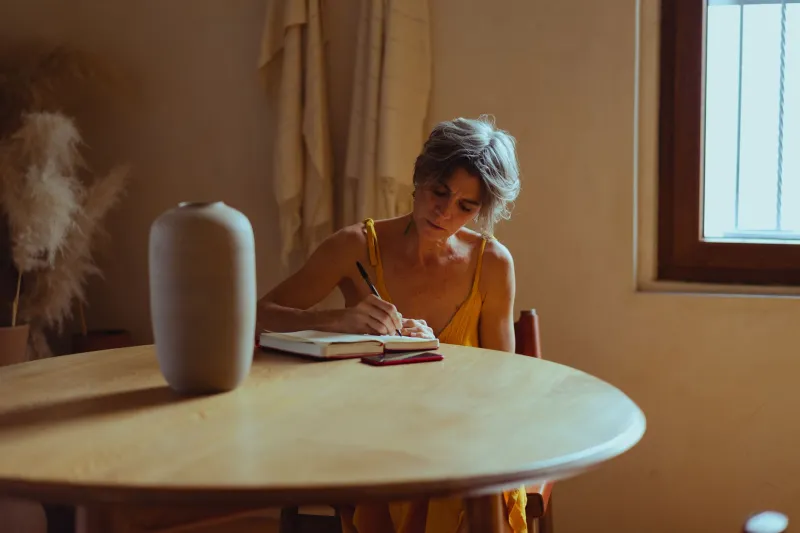
Sophia, a secondary school teacher from Bristol who travels for three weeks each summer, describes her journalling practice as "the conversation I can only have when I'm away." She writes every morning in whichever café she has adopted as her temporary local — a practice that has taken her from a corner table in Oaxaca to a harbour-side bench in the Azores.
"There's something about writing in a place where nobody knows you," she says, "that removes a kind of self-censorship I didn't even know I was applying. I've worked out more about my own life sitting in foreign cafés than I ever have in therapy. Which is either a recommendation for travel or a criticism of my therapist."
What a Practice Actually Looks Like on the Road
It is worth being specific here, because vagueness is the enemy of anything genuinely useful. The practices women describe carrying abroad tend to be modest in form, even when they are significant in effect.
Meditation, when it travels, is typically stripped of props. No cushion, no dedicated room, no app — though apps are not uncommon. A corner of the bed, the floor, a park bench before the city wakes. Duration tends to contract on the road: the forty-five-minute sessions of home become fifteen-minute anchors, sufficient to establish a thread of continuity through otherwise variable days.
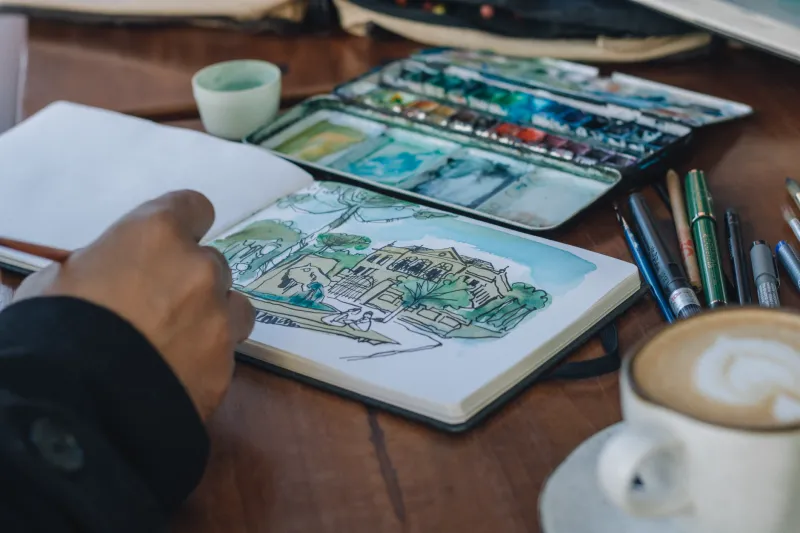
Journalling is perhaps the most naturally portable practice, requiring only a notebook and a degree of commitment. The women who do it consistently recommend separating it from the travel diary function — the record of what was seen and eaten and visited — in favour of something more inward. What am I noticing about myself in this place? What is the landscape making available that my ordinary life does not? These are not self-help prompts; they are genuine enquiries.
Personal ceremonies are harder to describe without sounding faintly eccentric, but several women mention small rituals that mark the beginning or end of significant journeys: a particular piece of music listened to on arrival, a letter written to oneself at the start of a solo trip and opened on return, a few minutes of deliberate silence at a threshold — a mountain pass, a shoreline, a temple precinct — that feels meaningful.
Claire, a 51-year-old freelance translator from London, has spent two consecutive Novembers in Kyoto, a city she chose initially for its autumn foliage and returned to for reasons she finds more difficult to articulate.
"There's a quality of attention in Kyoto that I find contagious," she says. "The way the raked gravel in a dry garden is considered, the fact that people queue quietly and don't speak on the metro. I'm not romanticising Japanese culture — I know it's more complicated than a tourist's impression. But something about being there makes me more deliberate. I walk more slowly. I look more carefully. I sit with my tea instead of drinking it while doing something else."
The Difference Between Retreat and Practice
It is important to distinguish between the structured environment of a women's retreat — which Voyageuse has examined elsewhere — and the more autonomous act of maintaining a practice within ordinary solo travel. The retreat provides scaffolding: a schedule, a community, a teacher. The practice carried independently requires something different, something closer to self-governance.
This is, for many women, precisely the appeal. To maintain a morning ritual in an unfamiliar city, without the architecture of a retreat to support it, is to discover that the practice belongs to you rather than to the context in which you learned it. This is not a small discovery.
A Note on Not Performing It
The risk in writing about any of this is the implication that it ought to be photographed, shared, or offered as evidence of a certain kind of cultivated selfhood. The women who travel this way tend, almost uniformly, to resist that framing.
The practice is private. The journey is personal. The interior landscape, it turns out, is the most interesting territory available — and entirely inaccessible to anyone who has not made the journey themselves.
The only equipment required is a willingness to sit with yourself in an unfamiliar room and see what surfaces. Which is, when you consider it plainly, a fairly accurate description of travel itself.