Steam, Silence, and the Sacred Scrub: What the World's Great Bathing Rituals Teach Us About Truly Letting Go
Steam, Silence, and the Sacred Scrub: What the World's Great Bathing Rituals Teach Us About Truly Letting Go
There is a particular kind of vulnerability that no amount of adventure travel quite prepares you for. It is not the vulnerability of a night train arriving in an unfamiliar city at three in the morning, nor the mild terror of ordering food in a language you do not speak. It is the vulnerability of removing your clothes in front of strangers, lying down on a warm marble slab, and allowing someone else to decide what happens to your body for the next hour.
I first encountered this sensation in Marrakech, on a Tuesday afternoon in February when the light outside the medina walls was the colour of old honey. I had been travelling alone for four days, and I was, in the way that solo travel sometimes makes you, simultaneously exhilarated and profoundly exhausted. A woman at my riad — a guest, not staff — told me I looked like I needed a hammam. She was not wrong.
The Hammam: Morocco's Architecture of Community
The traditional Moroccan hammam is not a spa. This distinction matters enormously, and misunderstanding it is the most common mistake a first-time visitor makes. A spa is a transaction. A hammam is a social institution — one that has served as a gathering place, a site of ceremony, and a space for female solidarity for centuries.
In the medinas of Marrakech, Fès, and Essaouira, neighbourhood hammams are separated by gender and operate on a simple, democratic principle: everyone enters, everyone is equal, and everyone leaves cleaner than they arrived. The architecture alone communicates something about intention. You pass through a series of rooms — cool, warm, and hot — each one peeling back another layer of tension, of pretence, of the particular armour that women are so often required to wear in public space.
The kessa glove, used by an attendant to exfoliate the skin, is not gentle. It is not meant to be. Watching grey rolls of dead skin accumulate on your forearm is, unexpectedly, one of the most liberating experiences available to a traveller. There is something clarifying about being literally stripped back.
For solo female visitors, the neighbourhood hammam is invariably safer and more authentic than the tourist-facing equivalents near the main souks. Les Bains de Marrakech and Hammam de la Rose offer excellent women-only sessions with English-speaking attendants for those who prefer a gentler introduction. However, if you are willing to navigate the experience with a phrase or two of Darija and an open spirit, ask your riad to recommend the local hammam used by residents of the neighbourhood. The experience will cost a fraction of the price and deliver something far richer.
Etiquette is straightforward: bring a swimsuit or underwear you do not mind discarding, a small towel, and savon beldi — the dark, olive-oil-based soap sold in every souk. Tipping your attendant generously is not merely polite; it is essential.
The Sauna: Scandinavia's Philosophy of Unbecoming
If the hammam teaches you to be tended to, the Finnish sauna teaches you to simply be. The Finns have a word — saunoa — which means, roughly, to take a sauna, but carries within it the weight of a practice so embedded in national identity that there are more saunas in Finland than there are cars. To dismiss this as mere hyperbole is to misunderstand an entire culture's relationship with the self.
I came to the sauna not in Finland, but in a small lakeside cabin in Swedish Dalarna, invited by a woman I had met on a walking trail. She was in her sixties, recently retired, and possessed of a serenity I found both enviable and faintly intimidating. The sauna, she told me as we sat wrapped in the particular silence that comes only from extreme heat, is where Swedes go to stop performing.
This is perhaps what strikes a British woman most forcefully. We are, culturally, a nation of performative composure — of stiff upper lips and polite deflection. The sauna strips this away with methodical efficiency. Sitting in 80-degree heat with nothing between you and another human being except a small linen towel, small talk becomes not just impossible but absurd. What remains is something more honest.
The ritual of the löyly — pouring water over heated stones to release a burst of steam — is a moment of collective breath-holding, a shared physical experience that creates intimacy between strangers with remarkable speed. In Norway and Sweden, mixed-gender saunas are common, though women-only sessions are widely available and easily requested. For solo travellers, Allas Sea Pool in Helsinki and Tjuvholmen Sjøbad in Oslo both offer excellent women-friendly facilities with harbour views that make the cold-water plunge feel like a reward rather than a punishment.
Bring nothing but yourself. Leave your phone in your locker. Stay longer than feels comfortable. That is, in essence, the entire instruction manual.
The Onsen: Japan's Grammar of Stillness
Japan does not ask you to relax. Japan creates the precise conditions under which relaxation becomes inevitable, and then steps back with characteristic elegance.
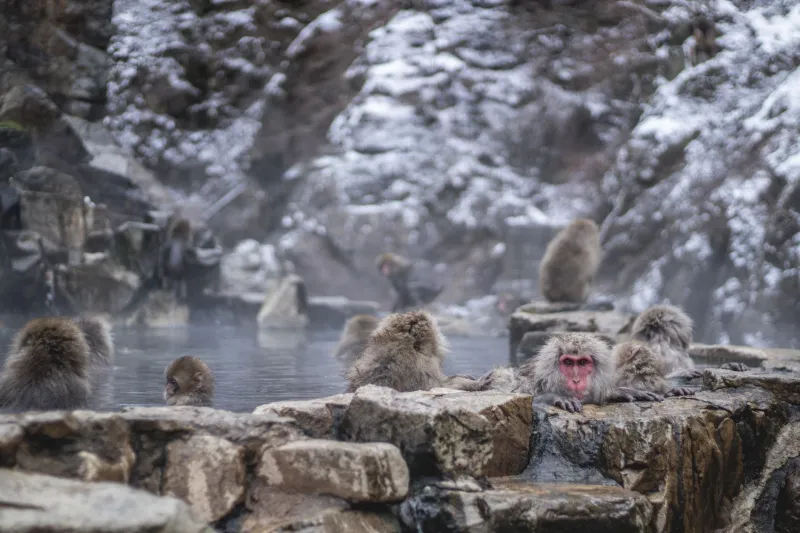
The onsen — a natural hot spring bath fed by geothermal water — is Japan's most quietly magnificent gift to the weary traveller. Unlike the hammam's sociability or the sauna's austere democracy, the onsen operates according to a grammar of stillness so refined it feels almost ceremonial. You wash yourself meticulously before entering the communal pool. You do not splash. You do not speak above a murmur. You lower yourself into water that smells faintly of minerals and ancient earth, and you remain there, very still, until time begins to lose its ordinary shape.
I found my onsen in Hakone, two hours from Tokyo by train, on a grey November morning when the mountains were half-obscured by mist and the maples were the colour of a dying fire. The ryokan — a traditional inn — was women-only for the morning bathing hours, and I was the only foreign guest. No one made me feel unwelcome. No one made me feel anything except, eventually, extraordinarily calm.
For British travellers unfamiliar with onsen etiquette, a few notes are essential: tattoos remain prohibited in many traditional establishments, though this is slowly changing in urban areas. Swimwear is not worn in most onsens — this is non-negotiable, and attempting to wear one will mark you immediately as someone who has not done their research. Menstruation is generally considered grounds for using the private bath rather than the communal pool; your ryokan will handle this discreetly if you enquire. Hakone Kowakien Yunessun offers accessible options for first-time visitors, whilst the onsens of Kinosaki Onsen in Hyogo Prefecture represent the tradition at its most immersive and architecturally beautiful.
What the Water Knows
There is a thesis buried somewhere in the steam of all three of these experiences, and it is this: the cultures that have built rituals around bathing have understood something that modern Western life — with its productivity metrics and its glorification of busyness — has largely forgotten. The body is not merely a vehicle for the mind. It carries its own knowledge, its own fatigue, its own need for ceremony.
For women in particular, spaces that are explicitly designed for physical ease and communal rest carry a significance that goes beyond mere relaxation. They are spaces in which the female body is not scrutinised, commodified, or required to perform. They are spaces in which the act of being human — warm, tired, briefly undone — is treated as sufficient.
To bathe abroad is not a frivolous addition to a travel itinerary. It is, I would argue, one of the most direct routes into the interior life of a culture. The hammam tells you about Morocco's relationship with community and the sacred. The sauna tells you about Scandinavia's relationship with honesty and the natural world. The onsen tells you about Japan's relationship with beauty, ritual, and the art of the unhurried moment.
All three, in their different ways, tell you something about yourself — specifically, about how rarely you allow yourself to simply stop.
The water, it turns out, has been waiting for you all along.