Carriage 7, Seat 42, Somewhere Between Now and Morning: The Case for the Night Train
There is a particular kind of exhaustion that belongs exclusively to air travel. You will recognise it: the 4 a.m. alarm, the fluorescent purgatory of the departure lounge, the strange compression of arriving somewhere entirely foreign whilst still smelling of your own kitchen. You have moved, certainly. But you have not truly travelled.
An increasing number of British women are refusing this bargain. They are choosing instead the measured, almost ceremonial experience of the night train — boarding in the early evening, watching the city dissolve into countryside through a rain-specked window, and surrendering to sleep somewhere over the Alps or the Rhine, only to wake, blinking and unhurried, into an entirely different world. The journey, in their reckoning, is not the inconvenience preceding the destination. The journey is the destination.
The Departure That Feels Like a Beginning
Anna Forsythe, a 38-year-old architect from Edinburgh, took her first night train to Vienna three years ago after what she describes as a moment of quiet rebellion. "I was standing in the security queue at Edinburgh Airport at five in the morning, shoes off, laptop out, and I thought: why am I doing this to myself? I'd been to Vienna twice before. I'd never once felt I'd arrived there. I'd just appeared."
She booked a couchette on the Eurostar to Paris, then connected to the ÖBB Nightjet service to Vienna — a route that has become something of a pilgrimage for the growing community of women who identify as slow travellers. "I had a glass of wine in the dining car. I read for two hours. I fell asleep somewhere in France and woke up in Austria. The light was extraordinary — that low, golden, early-morning light over the mountains. I cried, actually. It felt like something had been given back to me."
That sense of restitution — of time returned rather than consumed — is perhaps the night train's most radical offering. In an era defined by relentless productivity and the tyranny of the itinerary, to spend eight hours in a state of deliberate, horizontal transit is something approaching a political act.
The Routes Worth Knowing
For British travellers, the practical architecture of a night train journey typically begins with the Eurostar from London St Pancras to Paris Gare du Nord or Brussels-Midi. From Paris, the connections are gloriously varied. The ÖBB Nightjet network — arguably the finest in Europe — departs from Paris Est and reaches Vienna, Innsbruck, Zurich, and Hamburg. The Intercités de Nuit links Paris Austerlitz to the south of France, with services to Toulouse, Hendaye, and Briançon. From Brussels, the City Night Line successors offer onward routes towards Berlin and beyond.
Those travelling from the north of England or Scotland might consider the Caledonian Sleeper as a poetic overture — boarding in Inverness or Aberdeen, gliding south through the night to London Euston, then continuing by Eurostar to the Continent. The journey becomes, in this configuration, a kind of unfolding: Scotland to England to France to wherever morning finds you.
Booking requires a degree of forwardness — Eurostar connections and Nightjet couchettes sell quickly, particularly in summer — but the planning itself carries a particular pleasure. There is something deeply satisfying about studying a rail map, tracing a route with your finger, and understanding that the land between here and there is not simply distance to be endured but texture to be experienced.
What the Sleeper Carriage Teaches You About Yourself
Priya Mehta, a 45-year-old journalist based in Bristol, has now taken seven night train journeys across Europe, ranging from a solo trip to Barcelona (via a Eurostar connection to Perpignan and onward by regional rail) to a more ambitious crossing to Prague. She speaks about the sleeper carriage with an intimacy usually reserved for places one has lived.
"There's an enforced intimacy with yourself on a night train," she says. "Your phone signal drops in and out. You can't really work. You're in this small, rocking space with your book and your thoughts and the darkness outside, and it strips away all the noise. I've had some of the clearest thinking of my life on night trains. I've made decisions. I've let things go."
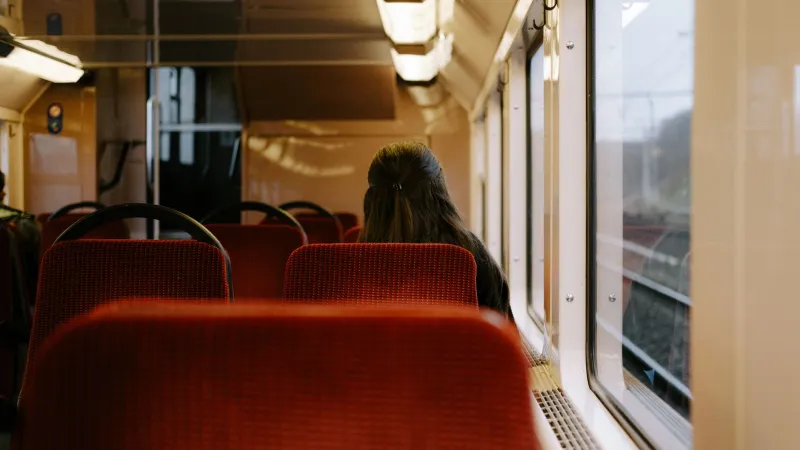
This psychological dimension — the night train as moving contemplative space — is one that several women describe unprompted. The sleeper carriage, with its narrow bunk and its curtained window and its rhythmic motion, creates conditions for introspection that the airport categorically cannot. You are, for those hours, neither here nor there. You are in transit, which is to say you are in one of the few genuinely liminal states modern life still permits.
The Sensory Pleasure of Watching the World Change
For those who choose not to sleep immediately — or who wake in the small hours, as travellers often do — the night train offers something the aeroplane never can: the visible, legible transformation of landscape. To watch the flat fields of northern France give way to the first suggestions of Alpine foothills, to notice the architecture shifting subtly at each illuminated station, to catch the reflection of your own face superimposed over a dark and moving world — this is travel as it was always meant to feel. Contingent. Embodied. Real.
Sophie Langton, a 52-year-old ceramicist from Bath who travels alone several times a year, puts it with characteristic directness: "On a plane, you're cargo. On a night train, you're a passenger. There's a difference that goes beyond the ticket price."
The Question of Carbon — and the Question of Character
It would be incomplete to discuss the resurgence of night train travel without acknowledging the environmental dimension. Rail travel produces, on average, between six and ten times fewer carbon emissions per kilometre than short-haul flying. For women who carry a genuine concern for the planet alongside their holdalls, the night train represents a choice that aligns values with action — not as sacrifice, but as pleasure.
And yet the most compelling argument is not ecological but existential. To choose the night train is to choose a particular quality of experience over mere efficiency. It is to insist that how you arrive matters as much as where you arrive. It is, in the most literal sense, to take your time — and to discover, somewhere between departure and dawn, that the time you took was entirely, beautifully your own.
The flight will get you there faster. But the night train will get you there changed. And for a growing number of British women, that is precisely the point.