Tides and Timetables: A Solo Woman's Journey Through the Hebrides by Ferry
Tides and Timetables: A Solo Woman's Journey Through the Hebrides by Ferry
There is a particular kind of freedom that arrives only when you have genuinely relinquished control. Not the performative surrender of a wellness retreat, but the real thing — standing on the car deck of a CalMac vessel somewhere between Oban and Craignure, watching the Scottish mainland dissolve into pewter mist, knowing that the sea, not your schedule, now holds the deciding vote.
The Outer Hebrides — that long, wind-scoured archipelago strung along Scotland's Atlantic edge — is one of the few places in Britain where the timetable remains genuinely subordinate to nature. Crossings are subject to weather. Ferries wait for no one, and occasionally, when the Minch decides to assert itself, they do not run at all. For the traveller accustomed to the precision of mainline rail or the tedious predictability of budget aviation, this is initially unsettling. Within forty-eight hours, it becomes the entire point.
Why the Ferry Is the Journey
CalMac — Caledonian MacBrayne, to give the company its full, unhurried name — operates over thirty routes connecting the islands of western Scotland. Its vessels range from small inter-island hoppers to substantial car ferries capable of weathering serious Atlantic conditions. To travel the Hebrides using this network as your primary mode of transport is to understand the islands on their own terms rather than your own.
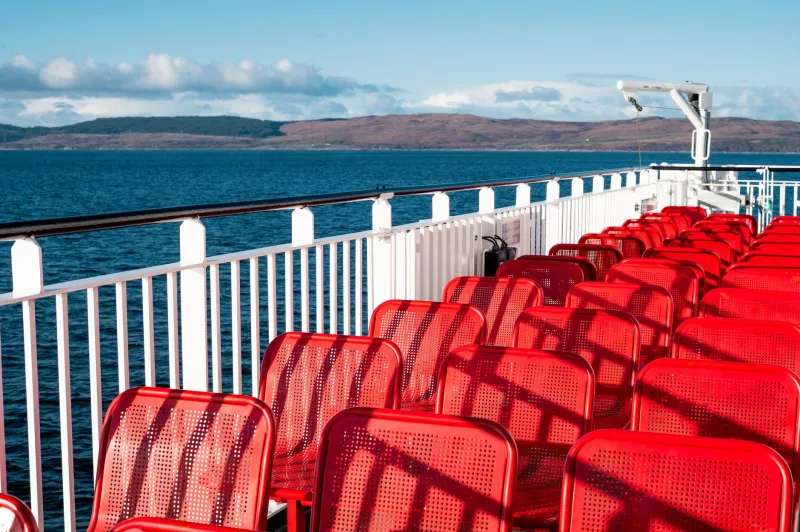
The ferry crossing between Ullapool and Stornoway, for instance, takes two hours and forty minutes on a calm day. This is not dead time. The upper deck, when the wind permits, offers a kind of enforced contemplation: the sea in every direction, gannets cutting low across the bow, the occasional dark comma of a seal. Below, in the lounge, conversations begin with the particular ease that enclosed spaces and shared journeys tend to produce. A retired teacher from Inverness. Two women cycling the Hebridean Way. A Gaelic-speaking islander returning home after a hospital appointment on the mainland, carrying a plastic bag of library books.
These are the encounters that a car or a hire van would have prevented entirely.
Building Your Island Passage
The most rewarding approach to a Hebridean ferry journey is not to plan too tightly. Purchase a rough framework — a sequence of islands you wish to visit, a sense of how many nights you can spend on each — and then allow the actual experience to adjust it. The CalMac website publishes its timetables in advance, but island-based accommodation providers will tell you, with remarkable candour, when the weather is likely to complicate things.
A considered route for a solo traveller with seven to ten days might begin in Oban, crossing to Craignure on Mull before continuing north and west. The ferry from Kilchoan to Tobermory is a short hop and gloriously scenic. From Mull, connections lead to Colonsay — small, unhurried, and frequently overlooked — before the longer passage north to the Outer Hebrides proper: Harris and Lewis, where the landscape achieves something close to the sublime.
Harris, in particular, rewards those who linger. The beaches at Luskentyre and Scarista are of a quality that would generate considerable tourist infrastructure were they located anywhere warmer. Here, they are simply there — vast and pale and frequently empty, backed by machair grassland that flowers extravagantly in early summer. Spend two nights on Harris rather than one. You will not regret it.
The Villages That Ask You to Stay
The Hebrides' smaller settlements operate at a register that is easy to miss if you are moving too quickly. Tarbert, the small port town on Harris, has a handful of excellent independent businesses — a coffee shop, a Harris Tweed outlet where the looms are still audible from the street, a community-run arts space that opens according to a schedule that appears to be negotiated fresh each week.
Lerags, Salen, Scalasaig: these are not destinations in any conventional sense. They are pauses. Places where you sit with a bowl of cullen skink in a pub that doubles as the local post office, where the barman knows the name of the man who caught the haddock, where the evening light does something to the water that no photograph has ever satisfactorily reproduced.
This is the texture of Hebridean travel that the island-hopper discovers and the day-tripper forfeits.
On Travelling This Route Alone
To travel the Hebrides solo as a woman is to be, almost without exception, welcomed. The islands have a long tradition of hospitality that is entirely unperformative — a cup of tea pressed upon you at a B&B, a local driver who insists on explaining the history of a standing stone you had not yet noticed, the ferry steward who points out a minke whale off the port side without ceremony, as though this were entirely ordinary.
The solitude, when you find it — on a cliff above the Atlantic, on an empty beach at low tide, on the upper deck at dusk — is of the productive variety. It clarifies rather than empties. Women who travel alone understand this distinction; the Hebrides happen to be extraordinarily good at providing it.
Practical matters are worth addressing honestly. Mobile signal is intermittent throughout the islands and absent in many places entirely. This is an adjustment for approximately one day, after which it becomes a relief. Accommodation ranges from well-appointed self-catering cottages to simple but perfectly adequate guesthouses; booking ahead in summer is advisable, particularly on the smaller islands where options are limited. A lightweight waterproof jacket is not optional.
What the Tide Teaches
There is a word in Gaelic — cèilidh — that translates imprecisely as a gathering, a visit, a coming-together. It implies informality and duration, a willingness to remain until the conversation has run its natural course. Travelling the Hebrides by ferry has something of the same quality. You arrive when the crossing is complete. You depart when the next one sails. In between, the island offers itself.
Britain has no shortage of beautiful places. It has very few places that insist, with such gentle authority, that you slow down enough to actually see them. The Outer Hebrides, reached by a network of ferries that bow to weather and tide, is among the finest of them — and for the solo woman traveller prepared to trade efficiency for depth, it constitutes an adventure of the most quietly radical kind.