Return to the Scene: The Fierce Alchemy of Going Back to Places That Once Broke You
There is a particular kind of dread that attaches itself to geography. Not to the abstract idea of a place, but to the specific, sensory reality of it — the smell of a particular metro station, the angle of afternoon light on a certain square, the sound of a language that once felt like home and then, suddenly, did not. For many women, certain cities become synonymous with the stories they most wish to rewrite. And so they avoid them, sometimes for years, sometimes for decades, rerouting their itineraries around the emotional cartography of their own histories.
But what happens when a woman stops rerouting? What happens when she buys the ticket anyway?
The Geography of Grief
Psychologists have long understood that trauma attaches to place. The brain is a cartographer of feeling, encoding memory not just as narrative but as location — a sensory address where the worst moments live. For this reason, avoidance feels rational. Why return to the city where you sat in a hospital corridor and watched someone leave the world? Why book a room in the neighbourhood where a relationship quietly collapsed over a series of ordinary dinners?
And yet, avoidance has its own costs. When a place holds power over us, it continues to exert that power from a distance. The mere mention of a city can tighten the chest. A friend's holiday photograph — the canal, the cathedral, the unremarkable café terrace — can arrive like a small ambush.
Catherine, 44, a secondary school teacher from Bristol, spent seven years avoiding Florence. She had honeymooned there in her mid-thirties; the marriage had unravelled spectacularly by the time she was forty. "Florence became a symbol of something I'd got catastrophically wrong," she says. "I couldn't even hear people talking about it at dinner parties without feeling a kind of shame."
She returned three years ago, alone, booking a small apartment in the Oltrarno neighbourhood specifically because it was unfamiliar — no honeymoon memories lurking in those narrow streets. "The first morning, I walked across the Ponte Vecchio and I waited for the grief to hit," she recalls. "And it did — but it was smaller than I expected. And underneath it was something else entirely. A kind of fury. And then, by the afternoon, something that felt almost like joy."
Reclaiming the Narrative
What Catherine experienced has a name in therapeutic circles: narrative reclamation. It is the process by which a person rewrites the emotional meaning of a place by inhabiting it under entirely different circumstances. The city does not change. But the woman who walks through it has, and that transformation reshapes everything she sees.
This is not the same as pretending the past did not happen. Women who have returned to difficult destinations consistently report that the grief, the anger, or the shame does not vanish upon arrival. It is present. It is simply no longer the only thing present.
Miranda, 51, a freelance photographer from Edinburgh, returned to Lisbon eighteen months after the death of her mother, with whom she had taken a memorable trip there in her mother's final healthy year. "I was terrified I'd be ambushed by memory at every turn," she says. "And I was, constantly. The pastéis de nata. The trams. The light — God, the light. But I was also just... there. Alive. Hungry. Curious. And somehow, being curious in the same streets where I'd once been so happy with her felt like the most loving thing I could do for both of us."
For Miranda, the return was not about closure — a word she finds reductive — but about expansion. "Lisbon doesn't only belong to that grief now. It belongs to both of us, and to me alone, and to whoever I'll be the next time I go."
The Particular Power of Going Alone
It is worth noting that virtually every woman who speaks about this kind of return emphasises the importance of solitude. Going back with a new partner, a group of friends, or even a well-meaning sister introduces a social performance into what is fundamentally an interior process. The presence of others — however beloved — requires the management of their experience alongside your own.
Alone, you are free to sit with the difficult feeling for as long as it requires. To order a second glass of wine and stare at the square that once witnessed your unhappiness. To cry in a gallery, if that is what the moment demands. To change your plans entirely, to walk in the opposite direction, to refuse the pilgrimage to the specific corner that holds the specific memory, or to walk directly to it and stand there, quietly, until it is simply a corner again.
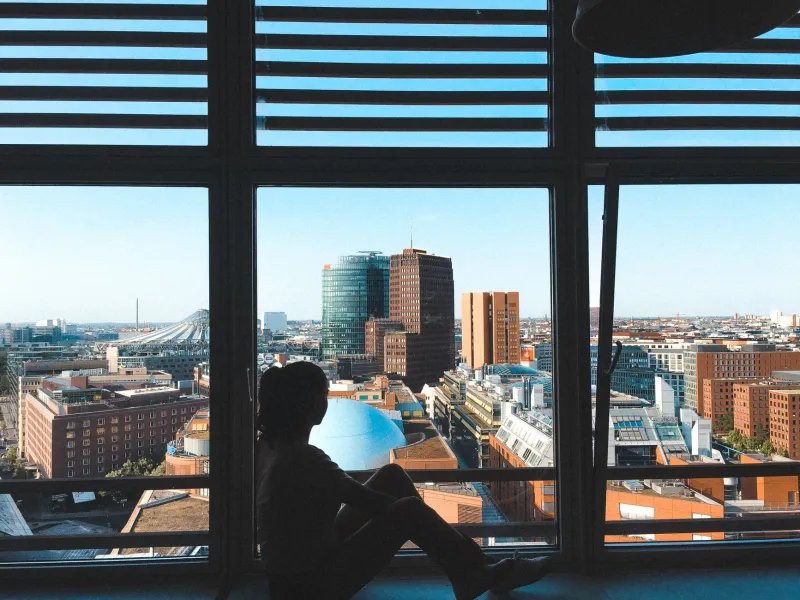
Sophie, 38, a marketing director from Manchester, returned to Berlin — where she had lived during a period of severe professional burnout — after two years away. She had left abruptly, feeling only that she needed to escape. "I'd built Berlin up into this place that had broken me," she says. "But when I went back, I realised that I'd been broken before I arrived. Berlin had just been the location."
That distinction — between a place that caused pain and a place that witnessed it — is perhaps the most important insight the return journey offers.
Practical Courage
If you are considering a return of your own, a few principles from women who have made the journey are worth holding.
Firstly, do not rush the decision. The return is most powerful when it is chosen freely, not when it is forced by circumstance or social pressure. If the thought of returning produces only dread with no undercurrent of readiness, it may not yet be time.
Secondly, consider staying somewhere new. A different neighbourhood, a different type of accommodation, disrupts the old script sufficiently to allow a new one to form. You are not recreating the past; you are inhabiting the same geography with a different self.
Thirdly, build in genuine unstructured time. The insights do not arrive on schedule. They come in the unremarkable hours — over a late breakfast, on a bench in an unfamiliar park, in the particular silence of a city at dusk.
And finally: go without an agenda for how you are supposed to feel. The return journey is not a therapy session with a predetermined outcome. It is, like all the best travel, an encounter with the unknown — which, in this case, happens also to be an encounter with yourself.
The places that broke us are still there, largely unchanged, entirely indifferent to our histories. And it is precisely that indifference that makes them so useful. They ask nothing of us. They offer no interpretation. They simply exist, patient and particular, waiting to see what we will make of them this time.