Stripped of Context: What Happens to a Woman When No One Knows Her Name
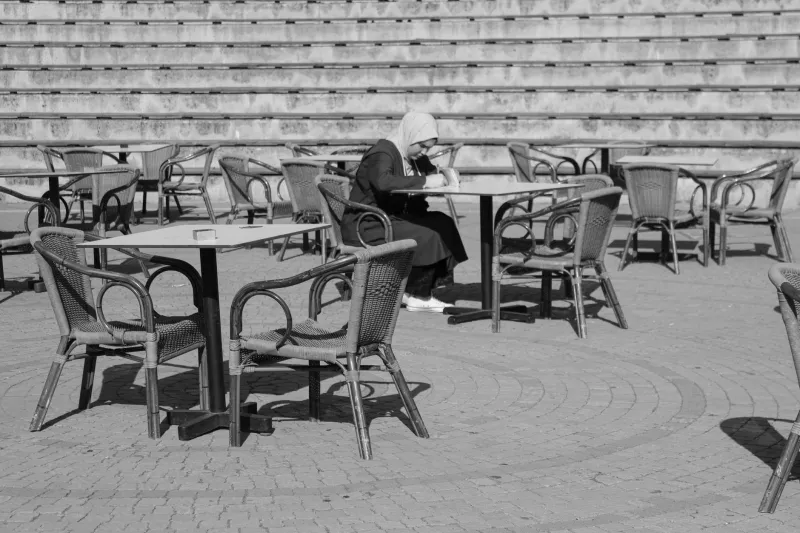
There is a particular moment, familiar to almost every woman who has travelled alone, that arrives somewhere between the second and third day. The notifications have slowed. The time difference has made you briefly unreachable. You are sitting, perhaps, at a café table in Lisbon or on a slow train through the Carpathians, and you realise that no one within a hundred miles knows who you are. Not your job. Not your history. Not the version of yourself you have been carefully maintaining for years.
For some women, this realisation produces panic. For others — and this is the group that tends to travel alone again, and again, and again — it produces something closer to relief.
The Architecture of Identity
Psychologists have long understood that much of what we consider our 'self' is, in fact, relational. We know who we are partly by the roles we occupy in relation to others: the competent colleague, the dependable daughter, the composed mother, the friend who always has a plan. These roles are not false, exactly, but they are partial. They are the architecture we build to navigate social life, and like all architecture, they can become so familiar that we forget they are constructed at all.
Solo travel dismantles that architecture with startling efficiency.
"I had been a GP for seventeen years," says Dr Priya Mehta, 44, from Bristol, who spent three weeks walking alone through southern Spain the year after her divorce. "My entire sense of self was bound up in being competent, in being the person with answers. The moment I was genuinely lost — not metaphorically, actually lost, on a hillside outside Ronda with a dead phone — I had to reckon with the fact that I had no idea who I was without the authority that role gave me. It was frightening. And then it was the most interesting thing that had ever happened to me."
What Priya describes is not unusual. It is, in fact, the central psychological mechanism that makes solo travel so persistently transformative for women who undertake it with any degree of genuine solitude.
The Roles We Didn't Choose
British women, in particular, carry a remarkable weight of social expectation. There is the professional expectation — to be capable, unflappable, modest about one's achievements. There is the domestic expectation, still stubbornly present despite decades of progress. There is the relational expectation: to be attuned, accommodating, emotionally available. And there is, perhaps most insidiously, the expectation of continuity — to be the same person, in the same way, for the same people, indefinitely.
Travel interrupts all of it.
Jade Okonkwo, 38, a secondary school teacher from Leeds, travelled alone through Japan for a fortnight two years ago. She describes an encounter at a ryokan in Kyoto that she still returns to mentally. "The woman who ran the guesthouse asked me what I did for pleasure. Not for work — for pleasure. I genuinely didn't know how to answer. I had been so thoroughly the teacher, the eldest daughter, the sensible one, that I had lost track of what I actually enjoyed when no one was watching."
The question sent her to a ceramics class the following morning, something she had never considered at home. She has since set up a small studio in her back garden. "Japan didn't give me a hobby," she says carefully. "It gave me permission to remember that I had desires that belonged only to me."
The Psychology of the Blank Slate
What travel offers — and what no amount of self-help literature can quite replicate — is a genuine change of context. Psychologists refer to this as 'identity disruption': a temporary loosening of the fixed narratives we carry about ourselves, which creates a window for new self-perceptions to form. This is not the same as escaping one's problems, a criticism often levelled at travel as self-discovery. The problems, as every experienced solo traveller knows, follow you faithfully. What changes is the absence of the audience that usually confirms your particular version of yourself.
Without that audience, you are forced to generate your own answers to questions that ordinarily go unasked. Are you brave? Flexible? Curious? Capable of sitting with discomfort? Do you actually like the food you always order at home, or have you simply ordered it so many times that it has become identity rather than preference?
These are not trivial questions. They are, in many ways, the most important questions a woman can ask herself — and the road has a way of demanding answers that a Wednesday evening at home simply does not.
Before You Leave: The Unmapping Begins at Home
The process of self-examination that travel accelerates need not wait for the departure gate. Several women I spoke to described beginning their 'unmapping' — a term I find more honest than the overused 'journey of self-discovery' — before they had even packed a bag.
Consider the following as a starting point:
Write down five things people consistently say about you. Not compliments, necessarily — just the phrases that recur. 'She's so organised.' 'She always knows what to do.' 'She's the quiet one.' Now ask yourself honestly: which of these feel true, and which feel like a role you accepted so gradually you never thought to question it?
Identify one thing you have not done because it didn't fit the version of yourself you've been performing. A language class. A solo dinner at a restaurant you've always passed. A weekend in a city where you know no one. Begin there.
Ask yourself what you would do on your first free afternoon if no one would ever know. Not the virtuous answer. The real one. That answer is a compass bearing worth following.
What Remains
Amelia Forsythe, 51, from Edinburgh, spent six months travelling alone through South America after her youngest child left for university. She is precise about what she found when the familiar scaffolding came down.
"I found that I was funnier than I thought. More impatient than I'd admitted. Genuinely moved by music in a way I hadn't let myself be in years. I found that I liked my own company enormously, which surprised me, because I had always been told I was someone who needed people around her."
She pauses. "I do need people. But I also need to be alone. And I had spent twenty-five years honouring only one half of that truth."
This, perhaps, is what the unmapped interior ultimately offers: not a new self, conjured from nothing, but a fuller account of the self that was always there — waiting, with considerable patience, to be properly introduced.
The world is large. The self is larger still. And the most extraordinary journey a woman can take is the one that leads her, through unfamiliar streets and unhurried mornings and the blessed anonymity of being a stranger, back to the person she was before the world told her who to be.