Stalls, Spices, and the Unscripted Truth: Why the Market Is the Most Honest Place in Any City
There is a particular kind of knowledge that cannot be acquired from a guidebook, a museum audio tour, or even the most eloquent of travel memoirs. It arrives instead in fragments — in the weight of a mango pressed into your palm by a vendor who wants you to understand that this, this, is the correct ripeness; in the sharp, clarifying scent of cumin hitting warm air; in the sound of two women arguing cheerfully over the price of dried figs while a child winds between their legs like a small, determined fish. This knowledge belongs to the market. And for the solo woman traveller willing to slow down and receive it, there is nothing more illuminating on earth.
Markets are not tourist attractions, even when tourists attend them. They are, first and foremost, functional — engines of daily life, governed by rhythm and relationship and the unsentimental logic of supply and demand. Which is precisely why they tell the truth. Walk into the Boqueria in Barcelona at seven in the morning, before the cruise-ship groups arrive, and you will see the city feeding itself: chefs with handwritten lists, elderly men selecting single portions of salt cod, teenagers buying pastries with the sleepy authority of long habit. Stay long enough, and you stop being a visitor. You become, briefly, a witness.
The Souk as Classroom
Marrakech's medina souks are, by any measure, one of the most sensory experiences available to a traveller anywhere in the world. They are also, to the uninitiated, profoundly disorienting — a labyrinth of alleyways organised by trade (here the leather workers, there the spice merchants, further still the weavers of silk) in a system that has operated, more or less, since the eleventh century. The temptation, especially for the first-time visitor, is to move quickly, defensively, with the fixed gaze of someone who does not wish to be engaged.
Resist it.
The souk rewards the woman who lingers. Not the woman who haggles aggressively and photographs everything, nor the one who purchases nervously and retreats — but the one who pauses, observes, and allows herself to be curious without agenda. Watch how a merchant arranges his wares at dawn. Notice which stalls the local women favour, and which they pass without a glance. Accept, when it is offered freely, the small glass of mint tea that means you are welcome here, not merely tolerated. The transaction, when it comes, will be more honest for the patience that preceded it — and your understanding of the place will be richer by an order of magnitude.
Valencia Before Noon
The Mercado Central of Valencia is, architecturally, an argument for the proposition that a city's relationship with food is a form of civic pride. Built in the early twentieth century in the Valencian Art Nouveau style, its iron-and-tile interior houses over nine hundred stalls and operates with the particular intensity of a city that takes lunch seriously. Come on a Tuesday or Thursday morning, when the paella ingredients are freshest and the fishmongers' displays achieve a kind of baroque extravagance — whole sea bass laid on beds of ice beside improbably orange prawns and the small, sweet clams that will, by afternoon, be in somebody's arròs a banda.
What the Mercado Central offers the unhurried traveller is not merely ingredient-spotting, though that pleasure is considerable. It is an encounter with the social architecture of Spanish daily life: the greeting rituals between regulars, the deference shown to older women, the way the stallholders speak about their produce with the quiet authority of people who have been doing this for generations. You do not need to speak fluent Spanish to read these dynamics. You need only to stand still long enough to see them.
Floating, Fleeting, and Entirely Itself
The floating markets of Southeast Asia — Damnoen Saduak outside Bangkok, Lok Baintan in South Kalimantan, the dawn market at Cái Răng in the Mekong Delta — occupy a category of their own. They are, undeniably, spectacular. They are also, in varying degrees, performative: some have been substantially reshaped for tourism, their authenticity diluted by the presence of the very visitors who came seeking it. This tension is worth acknowledging rather than avoiding.
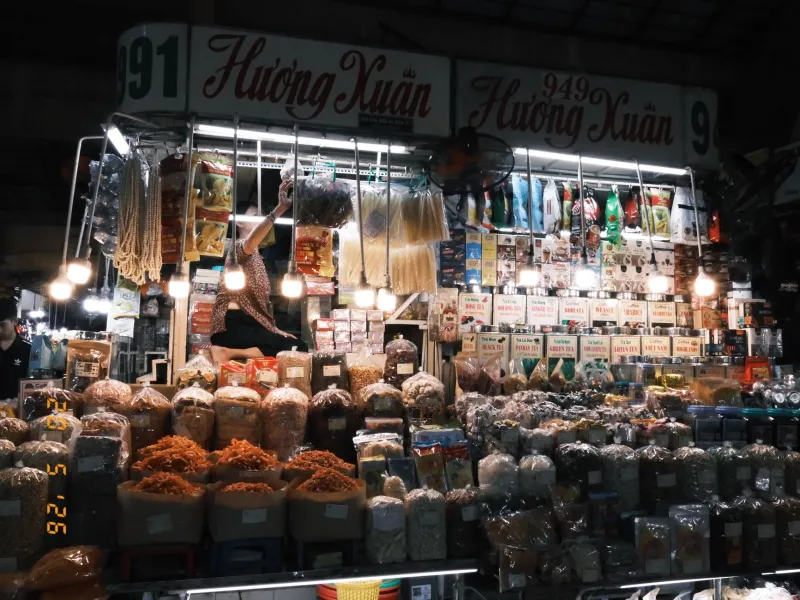
The answer is not to dismiss them, but to arrive early and look beyond the obvious. At Cái Răng, the serious commerce happens before six in the morning, when the wholesale boats cluster and the transactions are brisk and unsentimental. The women who run these boats — and it is predominantly women, a fact worth sitting with — are not there to be photographed. They are there to work. Watch the efficiency of it: goods transferred between vessels with a speed and precision that speaks of lifetimes of practice. The market, here, is not a spectacle. It is an economy, and the women at its centre are its architects.
Spending as an Ethical Act
There is a quietly political dimension to market travel that deserves to be named directly. When a solo woman traveller chooses to spend her money at a local market rather than in an international hotel gift shop or a brand-name restaurant, she is making a choice about where value flows. She is putting her sterling — and her time, and her attention — into the hands of the people who actually inhabit the place she has chosen to visit.
This is not a small thing. Tourism, at its worst, extracts from a place without returning much to it. Market travel, at its best, does the opposite. The stallholder who sells you a jar of preserved lemons in Fès, or a length of hand-blocked fabric in Jaipur, or a small pot of local honey in a Provençal village market, receives something more than a transaction. They receive the acknowledgement that what they make and sell and know is worth a traveller's considered attention. That is a form of respect that no museum visit, however culturally enriching, can quite replicate.
A Practical Manifesto for the Market Traveller
Arrive early. The best markets belong to the morning, and the best mornings belong to those who show up before the light has fully decided what it wants to be. Bring cash in small denominations, a bag that can hold more than you planned to buy, and the willingness to eat something you cannot identify. Leave the itinerary at the hotel.
Do not photograph without permission, and do not treat vendors as background characters in your travel narrative. Make eye contact. Attempt a word or two of the local language, even imperfectly — especially imperfectly. Accept generosity when it is offered. Decline pressure without guilt. Understand that haggling, where it is culturally expected, is a form of conversation rather than combat, and that the goal is not to win but to arrive, together, at a number that feels fair to both parties.
And when you have bought what you came for — or more likely, things you did not know you wanted until they were in front of you — find somewhere to sit, unwrap whatever you are carrying, and eat it there, in the middle of everything. Because the market is not a place to pass through. It is a place to be in, fully and without hurry, for as long as the morning allows.
The world, encountered at this pace and in these places, is endlessly, honestly itself.