Gloriously Lost: The Case for Wandering Foreign Cities Without a Map
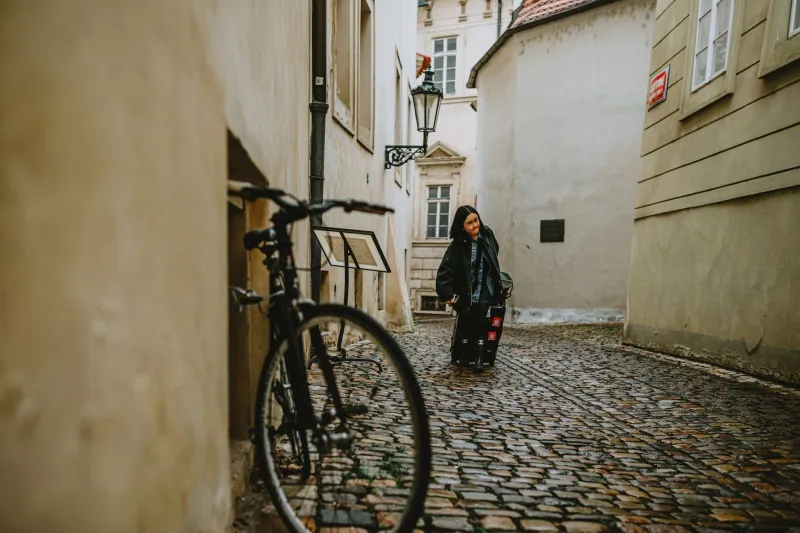
There is a particular kind of freedom that arrives the moment you fold away the map, silence the voice of your navigation app, and allow a city to become, at least temporarily, incomprehensible. It is not the freedom of the reckless or the unprepared. It is something far more intentional — and, for a quietly growing number of solo female travellers, something deeply transformative.
Call it strategic disorientation. Call it deliberate wandering. Whatever the name, the practice is gaining traction among women who have grown tired of experiencing a destination through the curated lens of someone else's itinerary, and who are choosing instead to court confusion, follow instinct, and let serendipity do the heavy lifting.
The Tyranny of the Perfect Itinerary
For decades, travel for women — particularly solo travel — has been framed largely in terms of safety, efficiency, and preparation. Know where you are going. Have a plan. Carry the right app. These are not unreasonable instincts, and they have their place. But somewhere in the relentless optimisation of the modern journey, something essential has been lost: the possibility of genuine surprise.
The guidebook — however well-intentioned — is, by its very nature, a filter. It selects, edits, and ranks. It tells you which neighbourhood is 'worth' exploring, which market is 'authentic', which café is 'hidden' (despite appearing in every travel publication for the past five years). Follow it faithfully and you will have a perfectly competent trip. You will also, in all likelihood, see the same city that thousands of other visitors saw last week.
Women who choose to wander without direction are not rejecting preparation — they are rejecting prescription. The distinction matters enormously.
What Getting Lost Actually Teaches You
Take Lisbon, a city of hills and unexpected vistas, where a wrong turn down a tiled alley can deposit you in a courtyard where an elderly man is playing fado to no one in particular, or where the smell of custard tarts drifts from a bakery that appears on no list. Or consider Naples, a city that actively resists comprehension, where the street plan seems designed to disorient and reward in equal measure. These are cities that yield their best secrets only to those willing to wander past the point of certainty.
The experience of not-knowing — of standing at an unmarked junction with no strong opinion about which direction to take — forces a quality of attention that is almost impossible to replicate when you are following a route. You begin to notice the texture of a place rather than its highlights. The laundry strung between windows. The particular light on a market stall at mid-morning. The way a city smells when the tourists have not yet arrived.
This is not romanticised nonsense. It is a fundamentally different mode of engagement, and those who practise it consistently report that their travel memories are richer, more specific, and more emotionally resonant than those accumulated via a conventional itinerary.
The Agency Question
There is something else at work here, beyond mere aesthetics. For many women, choosing to wander without direction is also an act of reclamation.
Women have historically been guided — by companions, by conventions, by the implicit assumption that independent movement through unfamiliar space carries inherent risk. The female solo traveller who strides deliberately into an unplanned morning in an unknown city is, in her own quiet way, refusing that framing. She is asserting that her curiosity is a valid instrument of navigation. That her instincts are trustworthy. That she is permitted to be confused without being in danger, and to be alone without being vulnerable.
This is not to minimise genuine safety considerations — awareness and common sense remain essential — but rather to challenge the idea that a woman's default relationship with unfamiliar territory should be one of caution rather than curiosity.
Misunderstanding as a Form of Knowledge
Here is the quietly radical notion at the heart of this movement: getting it wrong can teach you more than getting it right.
The traveller who misreads a street sign and ends up in a residential district rather than the old quarter has, in fact, stumbled upon something the tourist map never promised: ordinary life. The woman who takes the wrong bus and rides it to the end of the line discovers a neighbourhood the guidebook never indexed. These are not failures of navigation. They are a different kind of success.
Some women are taking this further still — actively choosing not to research a destination before arrival, arriving with little more than a sense of direction and an open afternoon. The deliberate misunderstanding of a city, they argue, creates a relationship with it that is entirely your own. Unmediated. Unshared. Yours.
Practical Wisdom for the Intentionally Lost
For those curious about trading the itinerary for instinct, a few considered thoughts from experienced wanderers:
Start with time, not courage. The single greatest enabler of purposeful wandering is a generous, unhurried morning. Leave the hotel with no agenda and a full three hours. Destination: nowhere specific.
Carry a notebook, not a map. Jot down what catches your eye — a colour, a phrase on a sign, the name of a street that sounds beautiful. You are building your own document of the city, one that will mean far more to you than any published guide.
Trust the wrong turn. When you realise you are not where you thought you were going, pause before reaching for your phone. Look up. Look around. Give the place thirty seconds before you redirect.
Eat where there is no English menu. Point. Smile. Accept whatever arrives. This is not bravery — it is appetite, which is rather better.
Return to the same place twice. If something catches you — a square, a bakery, a view — go back at a different time of day. Cities reveal themselves differently at dusk than at noon.
The Uncharted Self
Perhaps the deepest truth about wandering without direction is that it is not really about the city at all. It is about what happens to a woman when she removes the scaffolding of expectation and allows herself to simply respond — to be curious, to be surprised, to be occasionally baffled and entirely fine with that.
The cities we remember most vividly are rarely those we understood perfectly. They are the ones that unsettled us a little, that offered something we were not looking for, that refused to behave as the guidebook promised. They are the cities we met on their own terms.
The unguided tour, it turns out, is not a lesser version of travel. It may be the most honest version there is.