The Slow Crossing: Why the Ocean Liner Is Becoming the Most Radical Journey a Woman Can Take
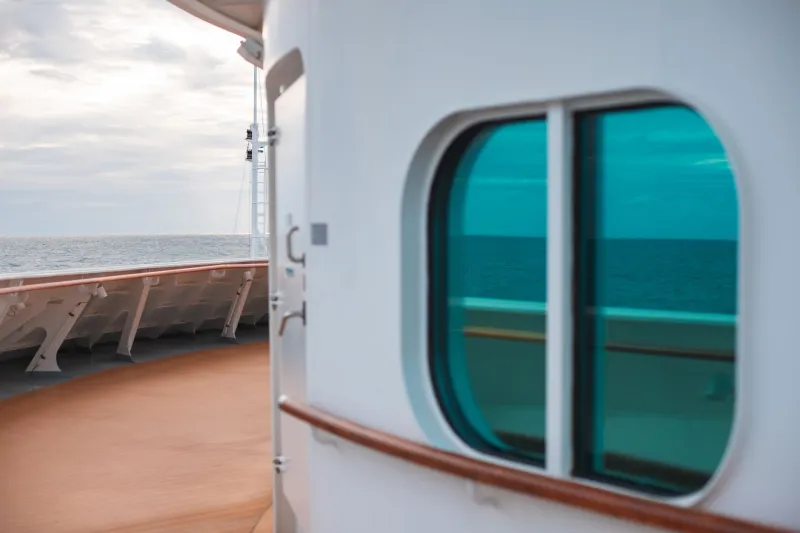
There is a particular kind of silence that settles over you somewhere around the second day at sea. The coastline is long gone. The horizon is unbroken in every direction. Your telephone has stopped pretending to find a signal. And the only thing asked of you — truly asked, with the full authority of the Atlantic — is that you remain present.
For a growing number of British women, this is not a hardship. It is, in fact, precisely the point.
While the travel industry continues to market speed as a virtue — faster connections, shorter layovers, seamless transfers — a quieter counter-movement is gathering pace. Women are choosing to cross water slowly. Not aboard the vast floating resorts that dominate the cruise industry's advertising pages, but on smaller, classically appointed vessels where the passage itself commands attention. Where the journey is not the inconvenient interval between departure and arrival, but the entire experience.
Not the Cruise You Are Imagining
It is worth being precise about what this is and is not. The ocean liner revival being discussed here bears little resemblance to the fourteen-deck behemoths that dock at Palma and disgorge five thousand passengers into a medieval old town. Those vessels have their devotees, and there is no judgement here. But they are, fundamentally, resorts that happen to float.
The liners attracting a different kind of woman traveller are those designed for crossing rather than hovering. The Cunard line's Queen Mary 2, which still operates a scheduled transatlantic service between Southampton and New York, is perhaps the most celebrated example — a proper ocean liner built for the North Atlantic, with stabilisers designed for serious seas and a crossing that takes seven nights. Then there are the smaller expedition-style vessels operating European coastal routes: through the Norwegian fjords, along the Iberian coast, across to the Azores. These are ships where the library is well-stocked and the deck is a place for genuine contemplation, not a venue for the next themed evening.
The distinction matters, because the psychology of the two experiences is entirely different.
What Happens When the Wi-Fi Disappears
Sarah, a 47-year-old architect from Edinburgh, crossed the Atlantic aboard the QM2 three years ago, initially motivated by a practical curiosity about whether she could manage without connectivity for a week. What she discovered surprised her.
"By day three, I had stopped reaching for my phone," she says. "Not because I was disciplined, but because there was genuinely nothing to reach for. And in that gap, I started to think in a way I hadn't managed in years. Long, slow, uninterrupted thoughts. I wrote thirty pages in a notebook I'd bought in the ship's shop. I had conversations at dinner that lasted three hours. I watched the sea change colour and texture every single day."
She arrived in New York, she says, not jet-lagged but recalibrated. "I felt as though I had actually moved through space, rather than been teleported. The distance felt earned."
This language of earning one's arrival recurs in accounts from women who have made deliberate sea crossings. There is something in the accumulation of nautical miles — felt in the body through the gentle roll of the vessel, measured in the slow arc of the sun — that no airport transfer can replicate. Psychologists who study transition and change speak of the importance of liminal space: the threshold state between one context and another. A seven-hour flight, with its pressurised cabin and recycled air and relentless entertainment options, does not offer this. Seven days at sea does.
The Routes Still Worth Taking
For women considering a deliberate ocean crossing, the options are more varied than the mainstream travel press tends to suggest.
Southampton to New York aboard Cunard's Queen Mary 2 remains the gold standard of transatlantic passages. Departures run throughout the year, with the crossing taking approximately seven nights. The ship is genuinely designed for the Atlantic — not a Caribbean vessel pressed into service — and the experience of sailing out of Southampton Water, past the Isle of Wight and into the open ocean, carries a historical weight that no departure lounge can match. Fares vary considerably depending on cabin grade and season; the most affordable inside cabins make this more accessible than many assume.
The Azores by freighter or small expedition vessel offers a less conventional but deeply rewarding option. Several operators run passages from British and Portuguese ports to these remote mid-Atlantic islands, and the crossing itself — four to five days of open ocean — is precisely the kind of enforced solitude that women returning from these journeys describe as clarifying.
Coastal European routes by classic ferry or small liner — particularly along the Norwegian coast with Hurtigruten, or through the Canary Islands — offer a gentler introduction to slow sea travel for those not yet ready for a full Atlantic crossing. These are working routes as much as tourist ones, and they carry a different quality of authenticity.
The Radical Statement in Choosing Water
There is something quietly political about this choice, and it deserves acknowledgement.
Choosing to travel by sea rather than air is, in the current moment, a statement about time — specifically, that your time is yours to spend as you determine, not as efficiency demands. In a culture that valorises busyness and equates speed with productivity, the decision to spend seven days crossing an ocean when you could fly in seven hours is, in its own understated way, an act of resistance.
For women in particular, who are statistically more likely to carry the invisible load of domestic coordination and professional over-extension, the deliberate removal of all connectivity and obligation for the duration of a sea crossing can be genuinely radical. There is no school run to arrange from the middle of the Atlantic. There is no email that can reach you. The ship's schedule is not yours to manage.
Julia, a 53-year-old GP from Bristol who made the QM2 crossing last autumn, puts it plainly: "I told my family I would be unreachable for a week. The look on their faces was extraordinary. And then I did it, and nothing collapsed, and I arrived in New York remembering who I was before I became so relentlessly useful to everyone else."
Arriving as Someone Slightly Different
Perhaps the most compelling argument for the slow crossing is the one that is hardest to quantify: the transformation that occurs not at the destination, but en route.
Women who fly arrive as themselves, slightly compressed. Women who cross by sea arrive as themselves, slightly expanded — by days of unstructured thought, by conversations with strangers that went somewhere unexpected, by the particular humility that the open ocean has a way of inducing in those who spend time upon it.
The horizon has a way of adjusting one's sense of scale. Problems that felt immovable before embarkation tend to look different after several thousand miles of Atlantic perspective. This is not mysticism. It is simply what happens when you give yourself time and space in sufficient quantities.
The liner is not a nostalgic choice. It is not a retreat into a romanticised past. It is, for the women choosing it now, the most forward-thinking travel decision available: a deliberate refusal of the instant, and an insistence that arriving somewhere should mean something.