The Empty Gallery: On the Transcendent Art of Being Alone in Sacred Spaces
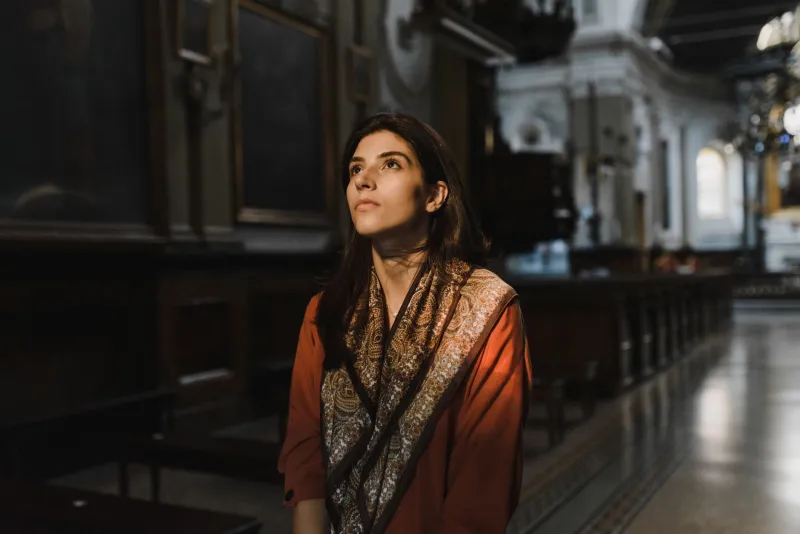
Consider the Uffizi at eight in the morning, before the tour groups have assembled in the piazza below. Consider the nave of Durham Cathedral on a weekday afternoon in February, when the only sound is the particular quality of silence that stone has held for nine centuries. Consider the small room in the Musée d'Orsay where Van Gogh's The Church at Auvers hangs, briefly, without an audience.
These moments exist. They are rarer than they once were, and they require a degree of intention to find. But for the women who seek them out, they represent something that no guided tour, however expertly delivered, can replicate: the unmediated encounter between a single human consciousness and a work of extraordinary human making.
The Tyranny of the Timed Entry
Modern cultural tourism has, with the best of intentions, created a particular kind of problem. The advance booking system, the timed entry slot, the one-way visitor flow, the audio guide that tells you what to feel before you have had the chance to feel anything — these mechanisms of crowd management have made the world's great cultural sites more accessible than ever, and simultaneously more difficult to truly experience.
This is not a complaint about accessibility, which matters profoundly. It is an observation about the relationship between attention and environment. Genuine contemplation — the kind that produces insight rather than information — requires a quality of stillness that is almost impossible to achieve in a room of two hundred people, each wearing headphones, each following an arrow on a laminated map.
The art historian T.J. Clark once wrote that looking at a painting is an act that takes time — real time, unreasonable time, the kind of time that modern museum-going rarely permits. He was describing the experience of standing before a Poussin for forty minutes, watching it change. Most visitors to the National Gallery spend an average of thirty seconds in front of any given work. Thirty seconds is barely enough to register colour.
Finding the Gaps
The architecture of opportunity, for those seeking genuine solitude in sacred spaces, is more generous than it might initially appear.
Many of the world's great cathedrals — including those in the United Kingdom — remain freely accessible during regular hours, without timed entry or crowd management systems. Winchester, Ely, Salisbury, and Lichfield are among those where it remains entirely possible to sit in a choir stall for an hour on a Tuesday morning, entirely undisturbed, in the presence of centuries of accumulated devotion and craftsmanship. The early morning service at many European churches — attended by a small congregation of regulars rather than tourists — offers a different quality of access again: participatory, intimate, and entirely outside the grammar of cultural consumption.
For galleries, the calculus is more complex, but not hopeless. Most major institutions observe quieter periods that can be identified with a modest amount of research. The Tate Modern on a weekday morning in November. The Rijksmuseum in the final hour before closing. The smaller, less celebrated rooms of the Louvre — those devoted to Dutch masters or Flemish cabinet paintings — that the crowds sweep past in their rush towards the Mona Lisa.
Emily, 47, a writer from Oxford, has developed what she calls a "deliberate slowness practice" in galleries and churches during her travels. "I give myself permission to see nothing," she says. "I walk in with no agenda, no list, no photograph to take. I sit down in the first room and I wait. Sometimes nothing much happens. But sometimes — and this is the thing I cannot adequately explain — something opens."
The Spiritual Geometry of Unstructured Time
What Emily describes as "something opening" has a long tradition in the literature of contemplative experience. The theologian Simone Weil wrote extensively about attention — not effort, but a particular quality of receptive, patient waiting — as the fundamental posture of the spiritual life. Her insight translates with surprising precision to the secular context of a woman sitting alone before a Rembrandt self-portrait.
The guided tour, for all its virtues, is fundamentally an act of transmission: knowledge moving from expert to recipient. Unstructured time in a sacred space is something different — an act of encounter, in which meaning is not delivered but discovered. The distinction matters because the meaning discovered through encounter is, by definition, personal. It arises from the specific intersection of the work and the particular woman standing before it, on this particular afternoon, in the particular emotional weather of her life at that moment.
This is why the same painting can devastate a woman at forty in a way it left her unmoved at twenty-five. The painting has not changed. She has. And only in the absence of commentary, agenda, and crowd is there sufficient space for that difference to be felt.
Laura, 33, a nurse from Glasgow, describes standing alone in the Sainte-Chapelle in Paris — having arrived at opening time specifically to be there before the tour groups — and experiencing something she struggles to categorise. "I'm not religious," she says carefully. "But standing in that light, in that silence, with those windows — it was the closest I've come to understanding why people build things like that. Why they dedicate their lives to it. It wasn't information. It was something I felt in my body."
A Practical Guide to Solitary Encounters
For British travellers wishing to cultivate this quality of experience, a few strategies are worth adopting as habit.
Arrive at opening time. This single adjustment makes a disproportionate difference. The first thirty minutes of opening hours in almost any cultural institution offer a quality of stillness that disappears entirely by mid-morning.
Research the overlooked rooms. Every major gallery has them — the galleries of minor works, the side chapels, the print rooms, the spaces that do not appear on the highlights map. These are often where the most unexpected encounters occur.
Leave the audio guide at the desk. On at least one visit to any significant site, resist the mediation of expert commentary. Allow the discomfort of not knowing what you are looking at. Allow yourself to simply look.
Sit down. The simple act of sitting — on a gallery bench, in a cathedral pew, on the steps of an ancient ruin — changes the quality of attention available. The standing visitor is, physiologically, in transit. The seated visitor has arrived.
Visit in the off-season. February in Florence, November in Seville, a Monday in October in almost any European city — these are when the great spaces breathe again, and when the woman who has planned for them discovers what all that stone and paint and glass was always trying to say.